
Follow us on Facebook for Training Tips
Physique Coaching Tips from Twitter
DeVine Physiques on Yelp!

Archive for the ‘Personal Training’ Category:

Training Related Footwear– What should you wear?

I’ve had many clients ask what is appropriate footwear to wear in the gym–  I’ve also had a majority of my clients that never ask at all, and don’t give much thought to it.

At the end of the day, though, what should you wear?  The answer:  It varies.

Cardiorespiratory Training – Running Shoes

Running Shoes

This one is probably a bit obvious, but it’s worth mentioning.  Running shoes should be worn when performing cardio related activities, and could also be considered when performing cardio related activities like plyometrics (“MetCon”).  Running shoes offer a lot in the way of support and shock absorption, but this makes them a less than stellar choice for weight lifting, as it’s not a stable base (in comparison to other shoes).

Plyometrics / MetCon – Training Shoes
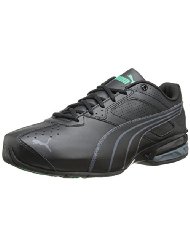
Crosstrainer Shoes

Running and Training shoes vary in a variety of ways, but a lot of people view them as the same sort of shoe.  Running shoes tend to be a very lightweight material that is meant to bend and flex, while training shoes tend to be a bit heavier, composed of leather (or synthetic leather) that keeps shape better.  This is useful in MetCon because it helps keep your foot stable during the movements; especially lateral movements where the foot can shift around in the shoe.  Even though they’re more rigid than running shoes, they do offer a level of shock absorption and support that other styles of shoes may not offer.  If you’re only going to buy one shoe for all of your activities, this would be the one to go with, as it can serve many purposes.

Olympic Weightlifting – Weightlifting shoes
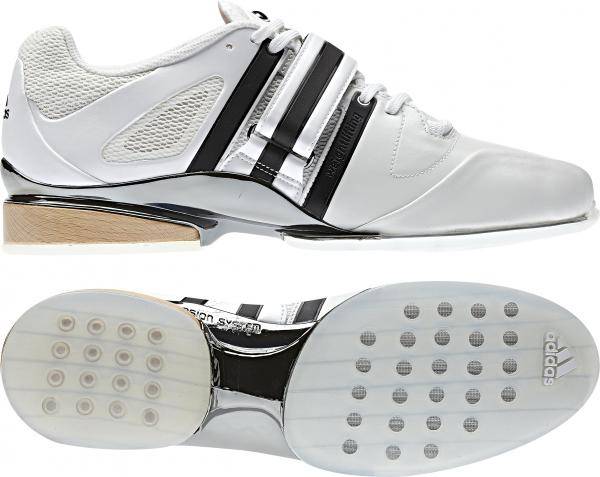
Olympic Weightlifting Shoes

Olympic Weightlifting Shoes

Weightlifting shoes are very specific–  They’re rigid, relatively heavy (depending on the style), and have a slightly raised heel that helps keep your ankle in a dorsiflexed position; this in turn helps you to maintain proper form during specific parts of the Olympic lifts.
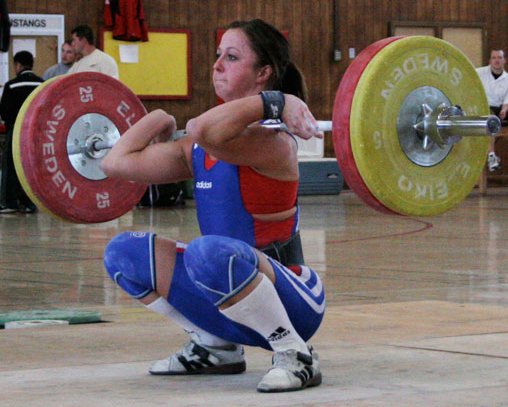
Weightlifting Shoes assisting the Clean & Jerk

Weightlifting Shoes: Helping you get ATG.

Weightlifting shoes may also be used for squats, as they provide a stable base, and can assist in hitting proper depth (because of the position is puts your ankle in).

Heavy Weightlifting / Powerlifting – Flat Shoes or Barefoot

For heavy weight lifting, a simple flat shoe is the best option out there.  It doesn’t have to be Chuck Taylors, but these are by far the most popular.  I wear, and recommend Leopard Print.
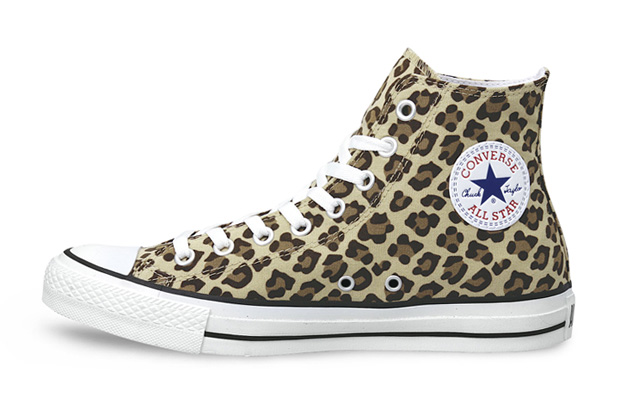
Leopard Print Chuck Taylor All Stars

The leopard print adds 20 lbs. to my deadlift.

This provides you with a stable base, your foot will always be in the anatomical position, and because the material of the sole is relatively thin, it also keeps you low to the ground.  The alternative to this is barefoot, where instead of there being a flat sole to provide a stable base, there’s the Earth serving the same purpose.

. . .  Except when there’s an earthquake.
Archive for the ‘Personal Training’ Category:

Training Related Footwear– What should you wear?

I interact with a lot of other personal trainers on forums, and here are some things that come up pretty frequently with new trainers looking for advice from more established trainers:

  1. How intense should a client’s workout be?
  2. How often should you change a client’s workout plan?
  3. Should you listen to clients who want more variety?

I want to take a moment to answer those questions, but before I do that, I want to paraphrase a response that a well seasoned trainer gave:

“You are a personal trainer, not a personal exerciser, right?”

So that begs the question: What exactly is a trainer?  What exactly is an “exerciser”?  A personal trainer is someone who trains you for a specific goal. . .  Which differs from a personal exerciser in that an exerciser is just making sure you get exercise.  Exercise doesn’t have to have a goal; it doesn’t have to have a method; it doesn’t even have to have a plan–  It’s activity with the intention of keeping you active, and that’s it.

Pictured: Not a Trainer.

Pictured: Not a Trainer.

In contrast, a training session is just one piece in a much larger puzzle.  During my consultation with each client, I ask them to sum up their health and fitness goals in one sentence–  This forces each person to really examine their goals and make them clear and concise.  From this goal, I can get started on a plan:

I look at how we would achieve this goal over the long term, and then break this up into smaller chunks (training periods); and within each training period, I can look at how the sessions should be structured.  Even within the sessions, I can look at progressions that can be made and benchmarks that should be met.  (Periodization is a lot more complicated than this, and involves more blocks and periods than I describe, but this is a very simple way of describing it!)  When someone comes in for the first session, I already know how the next 3 months should be done, and beyond in most cases, because I’ve already planned that far ahead. . .

Because I’m a trainer, training someone for a specific goal.

So, to answer those initial three questions:

  1. How intense should a client’s workout be?  As intense as they need to be to achieve their goal; keeping in mind that there are different ways to define intensity.  From an exercise science standpoint, intensity only refers to the amount of resistance you’re using on each exercise, whereas we typically think of intensity as perceived level of exertion.
  2. How often should you change a client’s workout plan?  A workout plan should be properly periodized, and should be changed as often as necessary for them to achieve their goals.
  3. Should you listen to clients who want more variety?  You should listen, and take them into account, and try and work in suggestions where possible–  However, keep in mind that you’re training them for a specific goal, and don’t compromise that.

Recent Blog Posts