Follow us on Facebook for Training Tips
Physique Coaching Tips from Twitter
DeVine Physiques on Yelp!

Archive for the ‘Health’ Category:

Tips for Success

  1. Commit to your goals.
  2. Go into each day with a plan.
  3. Drink at least 96 fl. oz. of water a day.
  4. When in doubt, eat more protein and vegetables.
  5. Get a food scale that offers metric (“gram”) measurements, and use it to measure as much of what you consume as possible.
  6. Measure everything you consume using the metric system.  (There’s a reason this is listed twice.)
  7. Get an account on Sparkpeople.com, or any nutrient tracking site / app (Like My Fitness Pal). Use this to plan your meals at the start of each day, and change it as your diet changes throughout the day.
  8. Stay within your calorie and macronutrient ranges.
  9. Own a Foam Roller, and use it often on sore muscles.
  10. Stretch on your days off from training.
  11. Make a conscious effort to improve your posture. This will help you avoid injury, and can lead to dramatic increases in strength.
  12. If you feel like you may falter toward your goals, call your trainer. Often times, talking to someone who is working toward their goals helps “keep you honest.”
  13. Contact your trainer whenever you need to.
  14. Make a schedule / develop a routine and stick to it.
  15. During your warm up, visualize your goals, and forge a strong bond between that vision, your mind, and your muscles.
  16. Use the Trainerize App often to track measurements and workouts.
  17. Encourage those around you. This can help you toward your goals, and also builds a support network.
  18. Leave your ego at the door before training. Doing an exercise correctly is more important the amount of weight you’re moving; Proper posture during cardio is more important than your speed / level of resistance.
  19. Stay Positive.
  20. Check the DeVine Physiques blog for the periodic update: http://devinephysiques.com/blog/
  21. Follow me on Instagram & Facebook: https://www.instagram.com/gabrieldevine.pt/ | https://www.facebook.com/GabrielDeVine.pt
  22. “Like” DeVine Physiques on Facebook: http://facebook.com/devinephysiques/

Archive for the ‘Health’ Category:

Tips for Success

It’s that time of the year again–  It’s the time when many people start to create their new year resolutions.  While I try and shy away from new year resolutions (I like to set goals throughout the year), I still take this time of year to look at creating some goals.

Resolutions often fail for a myriad of reasons, but it’s usually because no plan of attack was created–  It’s the idea that, January 1st is here, so I must achieve!  When that goal is not realized quickly (great things take time), it becomes discouraging, and by the time February 1st rolls around, we’re looking more concerned with whether it’s a leap year than what we resolved to do for the new year.  (2015 is not, by the way.)

So, choose to make new year goals, rather than resolutions–  but don’t stop there!  Create “SMART Goals.”  “SMART Goals” are Specific, Measurable, Attainable, Realistic, and Timely; by making SMART Goals, you can better set yourself up for success.  Here’s an example for how to create some fitness related SMART Goals:

Step 1: Figure out what you want to accomplish, and be realistic.  This is basically looking the broadest form of your goal, and it should be both attainable and realistic.  My goal is to compete in at least 2 bodybuilding shows this year at a better level of conditioning than last year.

Step 2:  Narrow down your goal into something very specific and measurable.  To continue with an example of one of my goals:  I competed last year at between 6 – 8% body fat. . .  So to create a specific, measurable goal for this year:  I will compete in 2 or more bodybuilding shows at <4% body fat.

Step 3:  Define a realistic deadline.  Deadlines can sometimes be trouble, because if you achieve your goal by the deadline, some have the tendency to give up their new found success / positive changes because to them, “it’s over.”  Part of most goals should include the caveat that this goal is part of a lifelong lifestyle change.  If your goal is to eat healthier by a certain date, your goal should also include moving past that date.  In a similar vein, you should also make sure that these goals can be attained in a reasonable amount of time– wanting to lose 10 pounds in a month is unrealistic and impossible.   To continue with my goal as an example:  I  will compete in 2 or more bodybuilding shows at <4% body fat starting in June 2015, and will correctly reverse diet out of the show to minimize body fat gain.

Step 4:  Turn your goal into a series of benchmarks.  Breaking your goal up into smaller goals will help you immensely–  Not only will it help you stay motivated, but it will also help you stay on track for your goals.  With my goal, I could figure out my starting body fat percentage, and from there, I could calculate how much body fat I would need to lose each month to stay on track toward my goal.  For ease, let’s just say that I would need to lose 4 lbs. / month to reach my goal.  I can then take that a step further and break it down into biweekly goals (weekly would drive me bonkers)–  I would need to lose 2 lbs. every 2 weeks in order to achieve my goals.

And there is one of my goals.  I started at the very broad goal of competing in 2 shows looking better than last year, and have narrowed it down to the SMART Goal of losing 2 lbs. every 2 weeks.  You can make it even more specific if you need, but that’s just one example of how you can set yourself up for success in the new year!

So what are your goals, and how will you achieve them?

Archive for the ‘Health’ Category:

Tips for Success

Are you a fan of frozen yogurt?  Most people are–  It’s a delicious treat that can be a relatively low calorie dessert, especially when compared to other desserts like ice cream, cake, etc.  Have you tried to track your frozen yogurt in your nutrient tracker?  Probably, but here’s a very important note about measuring your froyo. . .  In most cases, the Calories are reported per fluid ounce (fl. oz.),which is a volume measurement; however, the weight on the scale is just that–  it’s a weight measurement.

Weight measurements are much more accurate than volumetric; especially when you consider how many times you’ve brought a measuring cup to get frozen yogurt. . .  So how do we get our weight measurement converted into a volume measurement to accurately track our frozen yogurt?  Let’s start by figuring out the weight of the frozen yogurt alone–  You will do this by weighing the empty cup, weighing the final product, and then subtracting the values.

Froyo measuring

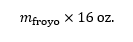
If the scale measures in ounces, you can skip this next step; however, if the scale measures in terms pounds (e.g. 0.50 lbs.), you will need to multiply the measurement on the scale by 16 to determine how many ounces you have.

2

Now that you have the accurate amount of ounces measured of froyo, we can use the density of froyo to convert from weight to volume.  I got this information from the head of nutrition at Menchies, and is a general measurement–  there may be slight variations between flavors, but it’s still enough to give us a pretty accurate measurement.  Take your weight measurement and divide it by the density (0.802) to give you your accurate volumetric measurement for your froyo.

3

These steps need to be repeated if you have different flavors, though if you do a swirl, that makes it easy since half of the volume will be one flavor, and the other half will be the other.  If you get toppings, be sure to subtract those totals from your froyo measurement, and don’t forget to track your toppings as well!

It’s worth noting that some places have started reporting their nutrition in terms of weight, which negates the need for most of this article; however, looking at the nutrition facts for Yogurtland and Menchies, you can see it’s still reported as volume. (In the case of Menchies, they report it “per 1/2 cup,” which is the equivalent of 4 fl. oz.)

The first time you calculate this, it will take a little thought, but after doing it once, it becomes very routine and is simply done on your phone’s calculator.

Archive for the ‘Health’ Category:

Tips for Success

Do you know what a complex carbohydrate is?  I would argue that most people don’t, as there are a lot of misconceptions about what makes a complex carb.  The term is thrown around a lot, and is used to mean “slow digesting,” or in some really incorrect cases, “healthy.”  One of my favorites is when people recommend only eating complex carbohydrates like fruits and vegetables.

. . .  Really?  Fruits?  Fruits are mostly “simple carbs,” which many associate with being “bad” for you.

When it comes down to it, whether a carbohydrate is “simple” or “complex” really doesn’t matter.

What is a carbohydrate?

In simplest terms, carbohydrates are sugars.  All carbohydrates, when digested, will be broken down into one of 3 simple sugars, which are called “Monosaccharides;” you may recognize the names of them: Glucose, Fructose, and Galactose.  (This is why carbohydrate choice ultimately doesn’t matter, since all carbohydrates consumed will be broken down into one of these, a topic I’ve covered before.)  (Source)

How are carbohydrates classified?

In broadest terms, carbohydrates can be broken down into one of two camps:  Simple Carbs, and Complex Carbs.  The difference between these is a very easy to understand distinction:  If the carbohydrates are present as single (or double) sugars, it’s a simple carb; if the carbohydrates form longer chains (of more than 2 sugars), it’s a complex carb.  Another name for a complex carb is “starch,” which is defined as a long chain of sugar molecules.  (Source 1 | Source 2)  You’ll notice that “starch” is used to refer to potatoes, which are frequently called “simple carbs” and people are told to avoid them.  That’s not the case.

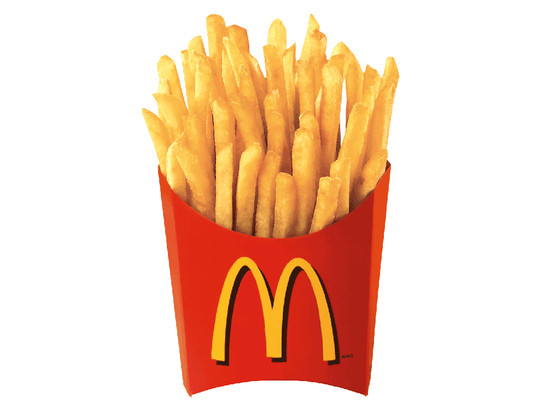
Pictured: Complex Carbs.

Pictured: Complex Carbs.

That’s all there is to it.  An easy way to think of carbs is like a chain–  Each link on the chain is a single sugar.  If you have 2 or less links, you don’t really have a chain, so instead, you have sugars:

8534439-abstract-3d-illustration-of-single-chain-link-with-golden-element

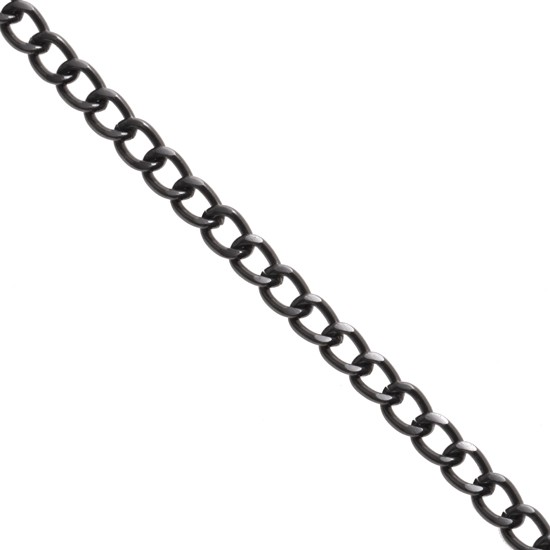
If you 3 or more links, that’s considered a chain, and that is a complex carbohydrate.  This includes a wide variety of foods, from potatoes to rice (both brown and white); from bananas to broccoli:

metal-chain-110225-gunmetal


So should I still pick brown rice over white if they’re both complex carbs?

If you’re going for the most healthful choice, going with the “brown” versions of foods is the better choice–  Brown Rice has more fiber, phytochemicals, and micronutrients than white; while both are tasty and fine to eat, if you want to make a choice that will offer more nutrition (and possibly keep you full longer), brown rice will be better.  Same with breads and other grains–  The whole grain option is a smarter choice, but that doesn’t mean that the alternative isn’t a complex carb.

Don’t get caught up on the nomenclature bandwagon–  Make smart choices that are right for you (which are hopefully the healthful choices), and you will be fine!

Archive for the ‘Health’ Category:

Tips for Success

I have a client that has seen tremendous progress–  She has lost 17 lbs. since training with me, and started in early May of this year (19 weeks).  Just like most people, though (myself included), she feels as though the progress could be quicker.

In most cases though, I don’t do things for speed–  I do them for quality; the shift in lifestyle; the healthy psyche along with the healthy body.  I stress a nonrestrictive diet because losing fat isn’t about reaching a finish line, or losing any sense of enjoyment with food.  Losing fat is all about making a positive lifestyle change that is healthy and sustainable.

Case in point, this client works in an office where a coworker is also losing weight, and at a slightly faster rate than my client.  That person, though, is on a popular meal replacement diet where they derive a majority of their calories through fluids.

Luckily, my client realized why my method of addressing lifestyle through nonrestrictive dieting is more important.  She asked her coworker what she’s going to do when she’s done with her diet, to which her coworker replied, “Oh, I can’t stop.  I’m just going to keep on the program indefinitely.”

What?  Indefinitely?  Rather than learn how to control your nutrition, you would rather sip protein shakes every day?  Where is the enjoyment from that?  Why not just track your food and control portions?  Why limit yourself?

Luckily, my client recognized this, and even brought that up to her coworker, asking why not just get a grip on her overall nutrition?  The coworker, of course, said that it would be too hard to track their nutrition.

I’ll never lie to anyone and say the nutritional aspect is easy, but which would you enjoy more:  Being able to eat whatever you want, or having to sip on protein shakes every day while not eating most foods out there?  Who would you rather be?

Archive for the ‘Health’ Category:

Tips for Success

6 years ago I was obese (BMI 32.35) and unhealthy. 5 years ago I was skinny and unhealthy. 4 years ago I started living a healthier lifestyle. 3 years ago I became interested in bodybuilding and lifting weights. 2 years ago I got serious about bodybuilding. 1 year ago I decided I wanted to do a bodybuilding competition. About 1 week ago, I stepped on a stage in a posing suit.

IMG_0431

It’s been a long journey that is far from over, and it’s fun to look back on other aspects of my life and see how they’ve evolved as well.  6 years ago, when I was obese, smoked a pack of cigarettes a day, and drank heavily, had you told me I would eventually become intensely passionate about health & fitness, and would change career paths to help people realize their health & fitness goals, I likely would have laughed.  And lit up a cigarette to spite.

. . .  But that evolution is a part of the journey.  Everyone is obsessed with the quick fix, or how fast they can get something done, but I’m here to tell you that life is not about the destination!  At the risk of getting too heavy for a blog post, if you look at all of our lives as a book, the first chapter starts in the same way, and the last chapter ends in the same way; what differs are the pages in between.

There are many bodybuilders that never step up on stage, instead opting to do “mock preps” so they can talk about preparing for a show without ever being judged.  They’re too scared to not win; they’re too scared they won’t step out on that stage as the winner they see in themselves, and they can’t handle the thought of failure.

. . .  But failure is where you learn from; and where’s the fun in that!?  With no knowledge of competing in bodybuilding, and without ever having seen a show, I decided to get on that stage, because life is about doing, and it’s about the journey.  It’s about what you learn along the way, whether it’s what foods work well for you while dieting, or how your body responds to dieting, or simply that you’re not very good at posing and you need to practice if you ever want to win a competition.

I didn’t win my first show, but that is perfectly okay!  Rather than talk about a goal I had set for myself, I went out and did it; sure, I may not have won, but I went the distance!  I had a blast, I learned a lot, and I can now call myself a natural bodybuilder.

When you’re on the path toward your goals, it’s important to keep your eyes on the goal, but it’s also crucial that you enjoy the ride while you’re getting there.  While my goal is to get my “pro card” as a natural bodybuilder, what’s the point if I don’t enjoy the journey (that could take years) along the way?  Even if your goals will only take a few months to achieve, what do they mean if you’re not enjoying yourself?

That’s why I advocate flexible dieting; that’s why I advocate taking risks; that’s why I advocate living the dream–  It’s important to enjoy the journey!

Archive for the ‘Health’ Category:

Tips for Success

Once upon a time, I had a nutrition client tell me they were considering doing a physique competition as a way to motivate themselves to lose weight quickly.

I told them this was not a good idea.

Why would you discourage someone?

It’s not very often that I would discourage someone from pursuing a goal.  In fact, that’s the only time I’ve ever done it, and here’s why:  Setting an extreme goal sets you up for failure.  It’s the same reason why crash diets don’t work; there’s a time limit on it–  A finish line.  The mentality this client had was that this would be a way to excuse an extreme drop in Calories for a short period of time to prepare for the show.

The question is, what happens after the show?  What’s the “exit strategy”?  Without developing a healthy relationship with food, and without understanding how to live a lifestyle of moderation, the second the finish line is reached, the pendulum could swing wildly in the opposite direction.

What if they kept up the weight loss?

Of course, continuing to live in a Calorie deficit isn’t the answer either.  That can lead to many different issues, including malnutrition, eating disorders, etc.

So what did you advise they do?

I advised them to lose weight at an appropriate, moderate pace without restricting themselves from any foods.  I advised exploring the idea of a competition down the road, but that should be done as a genuine desire to accomplish doing a show, not as “thinspiration” to achieve extreme weight loss.

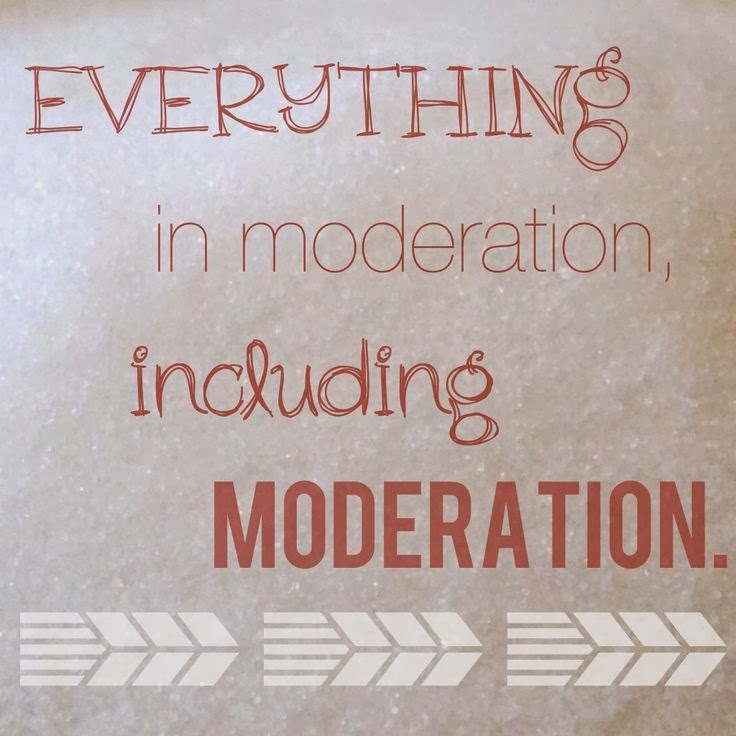
Extremism is easy; moderation is difficult.  From a food psychology standpoint, extremism is unhealthy, and moderation is healthy.  Practice moderation–  Enjoy yourself and the food you eat while achieving whatever goal you truly want.  Not only will this set you up for success, but you’ll be much happier in the long run!  Think about it:  Are you happier when you get to eat desserts / enjoyable foods in moderation, or when you completely restrict yourself from sweets?

One of the sources of my happiness.

One of the sources of my happiness.

Plus, transitioning from a flexible diet for weight loss to one of maintenance means the only thing that changes is the amount of energy (Calories) you consume;  this limits the chances of binges, Yo Yo-ing, and disordered eating patterns.

Archive for the ‘Health’ Category:

Tips for Success

Welcome to Part 4 of my series on flexible dieting–  Let’s recap:  We now know that all Calories really are just Calories (energy);  We also know that all carbohydrates end up as one of the same 3 compounds whether it comes from ice cream or a banana.  We’ve also learned that we need to be nonrestrictive in our food choices to avoid an unhealthy relationship with food and disordered eating patterns while increasing our chances for success and enjoyment.

So what is there to talk about now?

This isn’t a topic usually discussed with flexible dieting since most that follow this protocol focus on the idea that you can lose weight (or achieve any goal, really) while eating any food you want as long as you control your energy expenditure.  While that is true. . .  (Source)

. . . Following flexible dieting while being mindful of the healthfulness of your nutrition plan is important!  A topic I touch on with all clients, and that I stress with those who are in the more advanced stages of their nutritional planning, is the idea of variety and food choices.

I eat a variety of foods daily–  What variety are you talking about?

When I talk about variety, I’m not purely talking about different foods–  You could get plenty of variety of grains, but fail to really reap the benefits of “variety.”  An example is eating white bread, white rice, animal crackers, and refined pasta, all in the same day.  By variety, I mean selecting as diverse foods as possible in group, type, and color.

What do you mean by “Group”?

By group, I mean food group–  This is a fairly obvious, but in practice, most people find it hard.  When examining your nutrition for a day, ask yourself: are you getting multiple servings of fruits and vegetables?  Are you consuming a lean protein source?  Are you getting a dairy product, or dairy substitute?  Are you consuming a nut product and / or legumes?  Is there some whole grain in there?  Are you consuming a mix of carbohydrates, fats, and proteins?

These are the sorts of questions you should be asking when you look at your food for the day, and it’s a good idea to maximize variety–  Not only does this help to maximize the amounts of different vitamins and minerals, but it also gives you a wide assortment of phytochemicals, which have been shown to have plenty of positive health benefits.  (Source 1, Source 2)

As a subset of group, I also bring up “type,” because there are benefits of consuming different types of foods, as well!  Are you getting leafy green vegetables as well as cruciferous vegetables?  Are you deriving all of your grains from refined sources, or is there a mix of refined and whole grains?  Better yet, are all of your grains whole grain?  Are you consuming different types of meats / protein sources?

Group and type, as well as color, are ways to maximize the healthfulness of your nutrition plan.

Color?  You mean I have to discriminate against certain foods?
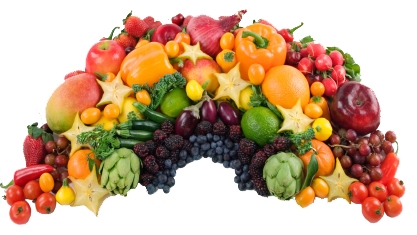
Not what most people think of when they hear "taste the rainbow."

Not what most people think of when they hear “taste the rainbow.”

The different colors of different foods help you to determine the nutrient and phytochemical content of the food.  (Source)  Red fruits and vegetables contain Lycopene (as well as countless other nutrients and chemicals), a powerful compound that might have an effect on reducing the incidence of certain cancers. (Source 1, Source 2)  That’s just one example.  There are many different compounds derived from all of the different colors; you can read more about it here.

It sounds like you’re only talking about healthy stuff. . .

When it comes to flexible dieting, there is definitely room for foods that aren’t necessarily nutrient dense–  That’s the whole point of it.  Rather than leave any food off limits, you make room for it.  Here’s something else to keep in mind, though:  Just because a food is more enjoyable, doesn’t mean you can’t think of the health benefits.  Take dark chocolate for example–  It’s packed full of vitamins, minerals, fiber, and phytochemicals.  (Source)  Does this mean you should eat 300 Calories worth of chocolate each day?  Not necessarily, but it also means that foods you may typically associate with being a “Free Food” (One that may not be that nutritious) isn’t always devoid of health benefits.  In fact, while there are foods / beverages that are nearly devoid of nutrition (chips and sodas), most foods have some nutritive value.

Is there a “wrong way” to do Flexible Dieting?

Here’s what I advise people do–  When tracking your nutrition, be sure to track your fiber intake from non supplemental sources.  If your fiber intake is adequate, the chances are, you’re making smart choices in your food, since you’ll be consuming a variety of whole grains, fruits, vegetables, nuts, legumes, etc.  So how much fiber do you need in a day?  (Source)

  • Fiber needs for Men: 38g / Day
  • Fiber needs for Women: 25g / Day

It’s also worth noting that, if your goals include fat loss, you’ll likely be eating in a Calorie deficit–  By choosing more nutrient dense, high fiber foods, you can help keep yourself full since fiber helps with satiety, and you can typically consume higher amounts of nutrient dense foods.  Don’t believe me?  Weigh out 100 Calories of Broccoli vs. 100 Calories of Chips, and tell me which food has more volume.

There is another way to do flexible dieting wrong, and that is the obsession with trying to eat a “perfect” diet.

There is no perfect diet; and remember that even an obsession with healthfulness can lead to a disordered eating pattern known as “Orthorexia.”  That’s why, as much as I love maximizing the healthfulness of my food, I eat ice cream, animal crackers, pancakes, chocolate truffles, See’s Bordeaux Eggs, and other less than nutritive foods on a daily basis–  I want to eat them, so why restrict myself?  Remember:
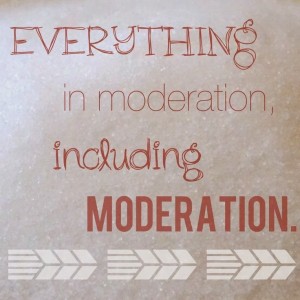
Words to live by.

Words to live by.

Plus, ice cream is a dairy source, right?  =)

What I recommend everyone do:  Leave between 10 and 20% of your Calories for the so called “free foods.”  At the same time, when selecting the foods for the rest of your diet, select options you enjoy!  This will help create a great relationship with your healthful nutrition plan!

Archive for the ‘Health’ Category:

Tips for Success

Welcome to Part 3 in my series on Flexible Dieting / IIFYM.  In part 1, we learned that where your Calories come from isn’t important since all proteins, fats, and carbohydrates, regardless of source, will be digested into the same thing; in part 2, we discussed what a Calorie is (just a unit of energy).  In part 3, which will be very a relatively short post, we’re going to talk about one of the most important principals regarding flexible dieting:  “Non Restrictive Dieting.”

How can a “Diet” be Non Restrictive?

I had a client once tell me that the nutrition plans I recommend are still restrictive because you have to restrict your Calorie intake.

When I (and others) talk about flexible dieting, “Non Restrictive” refers to food choices; not Calories.  No matter what, if you want to lose weight, you have to lower your energy intake–  That’s a characteristic of any weight loss plan.  (Source)  In fact, when it comes down to it, when it comes to Calories, every nutrition plan is restrictive in some way–  If you want to maintain your weight, you have to “restrict” yourself to eat at maintenance; if you want to gain muscle, you have to “restrict” yourself to eat only a certain amount above maintenance, otherwise you could gain a much higher amount of fat.

Non restrictive dieting is about choices, and following a non restrictive diet just makes it easier to maintain and more enjoyable.  Quite often, I tell my clients about some of the food choices I make, because it’s the easiest way to demonstrate how non restrictive diets work.  On a regular basis (while dieting down for a bodybuilding show), I eat chocolate truffles, ice cream, ice cream bars, cookies, baklava, etc.

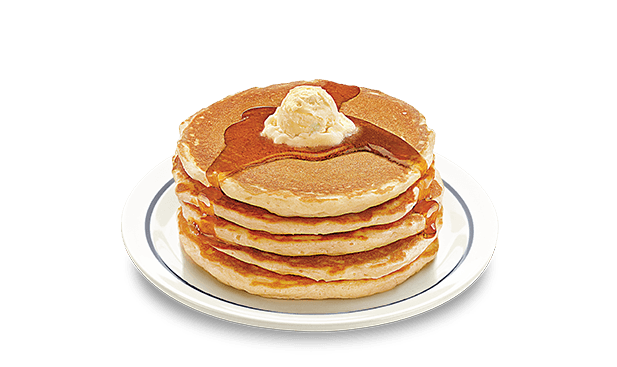
Pictured: Diet food.

Pictured: Diet food.

How do you do that and lose weight!?

Remember to our last posts:  What is most important is that I stay within my Calories (which I do every day); and my body can’t tell if the sugars I consumed came from a banana or a cookie.  I’m in a net energy deficit, which means I will lose fat.

So I can eat nothing but ice cream and pop tarts to lose weight!?

Remember the story of the nutrition scientist that basically did that?  If we’re talking about weight loss, then yes, you really can eat whatever you want since weight loss is dependent on energy balance.  However, that could lead to setbacks in your goals, health, and just general misery:

  • If all of  you eat are “empty Calories,” you’ll likely go over your Calories since these don’t have a very profound effect on satiety.
  • Similar to the above, if you live off of “empty Calories” and manage to stay within your Calories, you will likely spend the vast majority of your day starving.
  • By avoiding nutrient dense foods in favor of pastries and desserts, you risk not only becoming deficient in a number of micronutrients (vitamins & minerals), but you also miss out on valuable phytochemicals that may offer some great health benefits.  (Source 1, Source 2)

So what’s the point, then?

Non restrictive dieting seeks to make dieting more enjoyable, and also offers some psychological benefits:

  • Dieting is more enjoyable because you can make food choices you enjoy–  Rather than cutting out rice, pasta, or sweets, you can make room for them so that you can have them while pursuing your goals.
  • Non restrictive dieting helps to avoid eating disorders like binge eating disorder.  By allowing yourself the freedom to have desserts, you don’t run the risk of falling into a binge each time you eat them since there is no time period where you’re not allowed to have them.  Side note:  This is something I am still recovering from personally, and flexible dieting has made recovery more manageable.  (More information on Binge Eating Disorder)
  • Non restrictive dieting creates a healthier relationship with food.  By thinking about foods in terms of energy, nutrition, and enjoyment, rather than what is “good” and “bad” (or what you “can” and “can’t” do / have), you have more freedom!  You can go out and enjoy a meal with friends while dieting; if you need to change your foods around to better suit your schedule or social life, you can; etc.

You’ll hear a lot of flexible dieting proponents talk about a “healthy relationship with food,” because it’s a very important thing to have.  A bad relationship leads to psychological disorders, weight management issues, and more. (Source: Psychology Today – “How Do I Improve My Relationship with Food?”)

It’s important to note, though, that there is a way to approach flexible dieting that can be not as efficient as other ways–  Thus far, we’ve only looked at flexible dieting from a weight loss perspective.  While that’s a big part of the puzzle, we’re also interested in maximizing the diets healthfulness, and effectiveness. . .

Which is what we’ll be talking about next week–  Healthfulness, food choice, and variety!

Bonus Round:  Here’s a short quiz to evaluate whether you have a healthy relationship with food.  Even though I’m on a contest prep right now with the goal of getting my body fat as low as possible, I scored as having a healthy relationship with food!

Archive for the ‘Health’ Category:

Tips for Success

Welcome to Part 2 of my series on the principles behind Flexible Dieting, also known as IIFYM, or “If it fits your Macros.”

What is a Calorie?

In the simplest terms possible, it’s a unit of energy that your body utilizes.  If you want a more technical response:

“The amount of heat required to raise the temperature of one kilogram of water one degree Celsius” or: “A unit equivalent to the large calorie expressing heat-producing or energy-producing value in food when oxidized in the body”  (Source; More Reading)

Apparently we've found the answer to energy independence.

Apparently we’ve found the answer to energy independence.

Okay, so a Calorie is a unit of energy.

If you think of your body like a car, Calories are like gasoline;  Calories are stored as energy in food, and here’s how much is stored in each macronutrient:  (Source)

  • 1 gram of Carbohydrate yields 4 Calories
  • 1 gram of Protein yields 4 Calories
  • 1 gram of Fat yields 9 Calories.

It’s worth noting that while Alcohol is not a macronutrient, it does yield energy–  1 gram of Alcohol yields 7 Calories.

So here’s how to think about it–  When your body digests and absorbs food, it frees up the energy stored in the food.  It either uses it for immediate energy, or stores it (as fat) for later use.

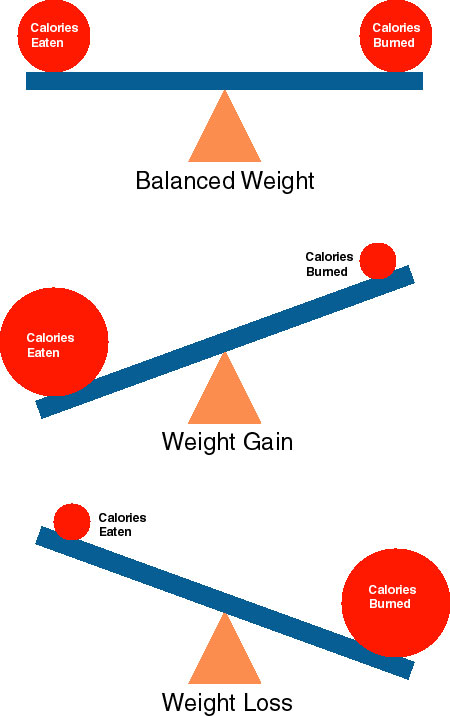
So in terms of energy, a Calorie is always a Calorie, since it is just a measure of the amount of energy in a food.  This is one of the fundamental principles behind flexible dieting–  Remember from last weeks post:  If you want to lose weight, you need to consume less energy than you burn.

Truth.

Truth.

Are there times when all Calories are not created equal?

The short answer:  Yes.

What is the long answer?

I have to reiterate that when you’re looking at energy balance, all Calories are equal.  We don’t want to look at food purely as energy, though–  There’s the entire “healthful diet” thing that everyone should consider.  When it comes down to what you eat, it should provide plenty of vitamins, minerals, phytochemicals, fiber, etc.  And this is where all Calories are not equal.

If we compare 100 Calories of banana vs. 100 Calories of soda, you’ll notice that they both have 100 Calories.  That’s obvious, right?  I mean, I said it’s 100 Calories of each.

Here’s where they differ, though; let’s look at what the Banana yields (Nutrition Data):

  • Energy derived from the macronutrients present–  Carbohydrates will be broken down into simple sugars (Monosaccharides) during digestion.
  • Fiber, which has many important healthful benefits from colon health to reducing cholesterol, among other things. (Source)
  • Micronutrients: These are Vitamins and Minerals, which your body requires to maintain physiological functions. (Source 1, Source 2)
  • Phytochemicals: These are chemical compounds that have been shown to offer great health benefits, but they are not required for survival, and more research needs to be (and is being) done on them. These are the chemicals people are referencing when they make the claim that “Red Wine is good for you;” they’re talking about “Resveratrol.” (Source 1, Source 2, Source 3)

Here’s a look at what the soda yields (Nutrition Data):

  • Energy derived from the macronutrients present–  Carbohydrates will be broken down into simple sugars (Monosaccharides) during digestion.

As you can see, there’s a great benefit to picking 100 Calories of banana over soda!  On top of that, sugary drinks take little time to digest, meaning they offer a lot of energy in a short time, and do nothing to satiate you.

While one could argue that this is an unfair comparison, it’s the sort of decisions people are faced with in every day life.  We could make the same comparison between a banana and a bag of chips, since both the chips and the soda are empty calories.

So what do you recommend?

Officially, as a nutritionist, I recommend you try and derive as much of your food from whole food sources as possible–  That means you can maximize satiety, micronutrient content, phytochemical content, and (usually) the amount of food you eat.  This is important to maximize the healthfulness of your diet.  Of course, that’s not an option for all of us, and we all enjoy foods that are processed (or just not whole foods). . .  That’s my “official” recommendation, though.

Here’s what I stick to on a daily basis for myself:  I try to get as much variety as possible in my diet when it comes to food choices, food groups, and even the colors of different foods (the color of fruits and veggies can clue you into the different phytochemicals present).  I also limit my consumption of non nutrient dense foods (So called “Free Foods”) to 1 – 2 food choices daily (Examples include cookies, pretzels, buttermilk pancakes, etc.) which usually comes out to between 150 and 200 Calories daily;  although, there are days where I don’t eat any free foods since I really enjoy everything I eat!

And that is the subject of next week’s post!  Most people think about a healthy lifestyle and think they can’t enjoy the food they eat.  Well, those people are not following sound advice.  Check back next week for Part 3 of this series where we talk about the importance of being “Non-restrictive” and flexible; hence, “Flexible Dieting.”

Any questions about this post?  Please ask!

Recent Blog Posts