Follow us on Facebook for Training Tips
Physique Coaching Tips from Twitter
DeVine Physiques on Yelp!

Archive for the ‘Fitness’ Category:

Muscle Imbalances

A big part of the NASM OPT Model is identifying postural and muscle imbalances in clients, and I’m fairly certain that everyone suffers from some sort of imbalance.  I was shocked by how many muscles were potentially out of balance when I did my first self assessment, but I’ve noticed a drastic change in my flexibility and range of motion (ROM) ever since working on fixing the imbalances.

There are a number of different postural distortions, and plenty of different movements to identify muscle imbalances, but we’re going to keep it simple today by looking at one postural distortion, what goes into muscle imbalances, and what it means to those who suffer from it:
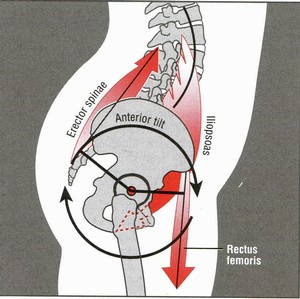
Lower Crossed Syndrome.  A surprisingly hard picture to find. . .

Lower Crossed Syndrome. A surprisingly hard picture to find.

Lower Crossed Syndrome (LCS)

This is characterized by an anterior tilt to the pelvis from an excessively arched back.  A way to spot this in the wild is by observing the waistband on one’s pants;  If, from back to front, the line of the waistband makes diagonal line downward, chances are you’re observing some level of LCS.  This is usually identified through a static postural assessment, where a trainer would look at your standing posture from the side. From this, we can identify what muscles are “underactive,” and which are “overactive.”

Underactive vs. Overactive Muscles

A muscle that is “Underactive” may also be referred to as “Lenghtened,” or “Functionally Weak.”  These muscles allow the distortion (or compensation) to occur because they lack the strength necessary to keep your body in correct postural alignment.  A example of this in someone with LCS is their transverse abdominis muscles.  The tilt in the pelvis puts the abdominal complex in a continuously stretched position, creating a weak group of core muscles that don’t have the strength necessary to keep the lumbo-pelvic hip complex in a neutral position.  Weakened abdominals also create a counterpart in their imbalance:  A muscle that is “Overactive” can also be referred to as “Shortened,” or “Tight” muscles.  These are the muscles that are continuously shortened / semi flexed, and lose a level of extensibility.  To expand on our example, with the excessively arched back from LCS, the erector spinae (lower back muscles) are continuously shortened, which leads to inflexibility in the back, and eventually low back pain.  It’s worth noting that these are two muscles mentioned as examples, but Lower Crossed Syndrome has an additional 5 overactive, and 5 underactive muscles.  Overtime, LCS can lead to hamstring strain, knee pain, and low back pain.

What can you do to fix it?

First, have a trainer assess both static and dynamic posture to identify postural imbalances.  Once you have your list of underactive and overactive muscles, you can do something about them!  For our underactive muscles, we’ve learned that they’re weak, so we need to make them stronger!  For the abdominal complex, great exercises would be planks and side planks to strengthen the core for posture.  For our overactive muscles, we need them to calm down and regain their proper extensibility.  Good flexibility training will take care of this;  and by “good,” I mean smart.  Start by foam rolling the overactive muscle to decrease muscle spindle activity, and be sure to hold on the tender area for at least 30 seconds.  (I’ll write a post soon about proper self myofascial release technique)  Then, static stretch the muscle for at least 30 seconds.  To improve muscle extensibility, you should engage in flexibility training 4 – 7 days per week.

And there’s your brief primer on muscle imbalances!  If you have any questions, be sure to post them or Email us!

Resources, Sources, and Links

Archive for the ‘Fitness’ Category:

Muscle Imbalances

Stretching is fantastic for you, and you should do it often!

Well that was easy.

Wait. . .  Yeah, I guess that, just like everything else in the health and fitness world, it’s not that easy.

So let’s start with how stretching works.  We’re going to split this up–  For the science, read this paragraph;  If science isn’t your thing, skip this paragraph.  That being said:  Stretching can be easily defined as improving the extensibility of a muscle by moving it through it’s full range of motion.  There are different types of stretching, but for this, we’re going to mostly refer to static stretching, which is holding a stretch for 30 seconds or more.  There is a neuromuscular response in the body known as “Autogenic Inhibition” that is used to increase the extensibility of muscles.  Without getting too involved:  In your muscles, you have muscle spindles that sense the length and speed at which a muscle is lengthened;  In the tendons that attach muscles to bones, you have “Golgi Tendon Organs” (GTOs) that sense the tension and rate of tension.  Autogenic Inhibition is where the tension experienced by the GTO overrides the impulse causing the muscle to contract;  Thus, it forces the muscle spindle to relax, allowing you to increase the extensibility of the muscle.  In order for you to benefit from Autogenic Inhibition, the stretch must be held for 30 seconds;  That ensures your muscle spindles have relaxed.  There’s more to all of this, but this is a very brief overview of how stretching works.

So, to recap, to gain the benefits of static stretching, you should hold the stretch for at least 30 seconds for it to work–  Less time and you may feel better, but you’re not doing much to increase flexibility.  So what are the benefits to static stretching?  Stretching, and Flexibility Training can:

  • Increase joint range of motion.
  • Relieve joint stress.
  • Improve neuromuscular efficiency.
  • Improve the extensibility of muscles.
  • Decrease tension of muscles.
  • And more.

From my own experience, I only ever stretched in between sets, and would hold the stretches for about 10 seconds or less.  (I now know that this was actually getting in the way of my goals;  More on that later.)  I was not flexible at all–  Who am I kidding, I’m still not flexible, but ever since I’ve incorporated flexibility training into my exercises, I have experienced less soreness after exercise, increased flexibility, and increased range of motion.  Alissa has also benefited from the flexibility training and is now going ATG on squats.  So from experience, I can tell you that even 3 weeks of flexibility training can make a huge difference.

Now, there are many people that say that stretching before working out for you is bad.

. . .  And they’re mostly right.  Studies have found that static stretching before activity may decrease strength and power for up to 10 minutes after the stretching, but there is little evidence that it has any impact on overall general performance. So when should you stretch?

If you’re engaging in maximal effort exercises or activities (Powerlifting, Heavy Lifting, Sprinting, Competitive Sports, etc.), it’s recommended that you either don’t stretch, or you do active / dynamic stretching only as part of your preworkout warmup.  If you’re engaging in any other sort of activity, static stretching prior to workout is still recommended, especially if you have particular muscle imbalances.  (Of course, don’t stretch during your workout, as this will further reduce strength and power output.)  After your workout, at a minimum you should be stretching the muscles you stretched preworkout, and it’s also recommended that you stretch muscles that were worked during your workout.

Sources and Links

Archive for the ‘Fitness’ Category:

Muscle Imbalances

Have you ever been really sore following an insane workout, and had someone tell you it was “Lactic Acid Build Up”?  Well, I’m sorry to tell you this, but Lactic Acid has nothing to do with you being sore, unless we’re talking about during the workout–  That could actually cause soreness fora minute or so.  If you’re sore after a workout, it’s something called “DOMS:”  “Delayed Onset Muscles Soreness.”

Not pictured: Lactic Acid Buildup.

Not pictured: Lactic Acid Buildup.

To start, what is Lactic Acid?  Without getting too far into it:  Lactic Acid is a by-product of Anaerobic Glycolysis.

The chemical breakdown of glucose for the production of “ATP” (Adenosine Triphosphate- Most easily described as a unit of energy for muscles) without oxygen (During weight lifting, sprinting, etc.) produces lactic acid;  When oxygen is present (Jogging, running, bicycling, etc.), the process is “Aerobic,” and instead of producing Lactic Acid, your body produces Pyruvic Acid, which can then be used to fuel other oxidative processes for energy metabolism.  There are two methods for removing Lactic Acid after production:  Oxidation into Pyruvic Acid to fuel the Krebs Cycle, or it can be converted into Glucose in the liver via Gluconeogenesis for energy.

Science aside, what does that mean?  Your body produces a chemical that can cause momentary “burn” in muscles because you’re exerting yourself, and then clears the pathways shortly thereafter.  Think of it like this–   Let’s say you have to climb 10 flights of stairs.  For the first flight or two, you will “feel the burn” in your legs, because your body hasn’t increased respiration to increase oxygen supply, so your body is producing energy through Anaerobic Glycolysis.  After the fourth flight of stairs, your body has increased respiration, and is now producing Pyruvic Acid instead of Lactic Acid, and you’ve begun an anaerobic workout–  At the same time, the increase in oxygen supply is allowing some of the Lactic Acid to go through oxidation, while the rest is being shuttled to the liver.

Here’s another example to demonstrate that it can’t “build up:”  You climb 2 flights of stairs–  The entire process was Anaerobic, so your body produced Lactic Acid;  You feel the burn in your legs as your arrive at your destination on the third floor.  After a very short while, your legs no longer burn.  Why?  You’re now in an aerobic method of energy metabolism–  You’re not taking in any more oxygen, but you’re also no longer exerting yourself;  The Lactic Acid was converted to Pyruvic Acid for energy metabolism.  (Anything left over was then sent to the liver.)

So, if someone says they’re suffering from Lactic Acid buildup from a few days ago. . .  They’re not.  What they’re experiencing is “DOMS.”  DOMS is soreness, inflammation, and pain associated with particularly tough workouts, workouts too intense for the trainee, or a workout that involves intense movements the trainee is unaccustomed to.  It’s often felt between 24 and 72 hours post workout, and is the result of microscopic tears in the muscle tissue that lead to inflammation and soreness.

DOMS is very unpleasant, but is not a sign that you did anything wrong, unless you’re just starting a workout plan–  In that case, DOMS means that you started off too intensely and should have ramped up.

Archive for the ‘Fitness’ Category:

Muscle Imbalances

A lot of people have a tendency to get too crazy with not just their workout routines, but their nutrition plans and everything else in life–  I foresee it will only get worse as time goes on because of the overabundance of information out there, and the Internet makes everyone feel like what they’re saying is right, even if it’s just “BroScience.”

. . .  It’s a problem.  Don’t get me wrong–  I’m guilty of this too.  I will read about new nutritional news, workout plans, etc., and will immediately want to try it out.

There are a few things to keep in mind, though.  If your plan is working, you don’t need to change anything.  (Unless it’s something like cleaning up your diet.)  If you’re getting the results you want, there is no reason to move on to anything else unless you’re doing something considered unhealthy (or unsafe), and are moving to the better option.

More importantly, don’t complicate things–  Remember “K.I.S.S;”  “Keep it Simple, Stupid!”  This is what everyone should live by, as it’s the easiest way to lose track of the basics, and the basics are what are proven to work.

Want to try a weight training program split into 6 days where forearms and biceps have their own day, and you do 12 sets that day?  K.I.S.S.!  Full body workouts, or smaller splits are the most effective, and anything past that is insane.  Plus, if 6 time Mr. Olympia Dorian Yates says low volume training is effective, it’s worth listening.  (After a lot of research, we’ll be doing a post about low volume training soon.)

You spend how long in the gym on Biceps Curls?

“Hah! You spend how long in the gym on Biceps Curls?”

Want to try and incorporate a lot of different ideas from a lot of different fad diets to try and create your own “Super Diet”!?  K.I.S.S.!  Fad diets are set up to fail, and even if you’re going to try and follow a fad diet, only follow one.  Those things are hard enough to stick to without over complicating things.

"If I read every one of these, I will finally be able to lose weight, right?

“If I read every one of these, I will finally be able to lose weight, right?

Never been to the gym?  Is your goal to suddenly lose 100 lbs?  Do you plan on getting there with 7 days in the gym doing non stop cardio and starving yourself?  K.I.S.S.!  You’re setting yourself up to fail–  You can workout anywhere from 3 – 6 days a week and still reach any goal you have, and starving yourself is not necessary.  Keep it simple- –  A simple workout plan coupled with eating 500 calories below maintenance will make it happen at a great pace, safely.

I could keep going on with examples, but ultimately, the point I’m getting at is, don’t complicate things, and don’t forget the basics.  Too many people get caught up in all the fine details and all of the noise polluting the health & fitness industry, so much so that the basics are ignored, and everyone has a difficult time achieving their goals.  Stuck?  Confused?  Lost?  K.I.S.S.  Everyone’s goal can be met with calories in vs. calories out, simple workout routines, and simple cardio-respiratory exercise.

Play smart, and keep it simple.

(Side note:  You may have noticed the name of the blog changed–  There are big things coming up soon for us, and we’ll be starting a new health and fitness website called “DeVine Physiques.”  Stay tuned for details!)

Archive for the ‘Fitness’ Category:

Muscle Imbalances

“Hey, Gabriel. . .  Can you help me get in shape?  I want to tone up for summer; I don’t want to count calories though.”

I can’t tell you how many times I’ve heard that, or some variation of it.  Everyone wants to get the “beach body,” or “tighten up,” but no one wants to put in the proper work.  Here are a few things to keep in mind about getting in shape:  “You can’t out train a bad diet.”  And of course, “Abs are made in the kitchen, not in the gym.”  And let’s not forget the very true, “A good physique is 80% diet, and 20% training.

I have had countless people ask, “What’s a good workout to get abs,” but when I tell them they can get a six pack by going to the gym once a week and changing their lifestyle, suddenly they lose interest.  Why is that?  Convenience.  Nobody wants to count calories, but everyone should be counting–  And here’s the important thing to note:  Not only do you need to count calories if you want to lose fat. . .  You need to count calories if you want to gain muscle, and also if you want to just maintain.

What!?  Why is that!?  Counting calories is annoying!?  First, let’s look at it in terms of fat loss:  How do we lose weight?  We figure out our Total Daily Energy Expenditure (TDEE, or “Maintenance”) and eat less calories than we that.  If you’re not counting, how do you know how many calories below maintenance you’re eating?  Are you eating below maintenance at all?

Of course, then comes: “Can’t I just do more cardio!?”  No.  Look above:  “You can’t out train a bad diet.”  If your TDEE is 2000 calories, and you eat 3000 a day, that means that you would have to train long enough to burn 1000 calories.  The more you train, the more you consume, unless you have unbelievable self control, in which case, why aren’t you just counting calories?  Let’s take it a step further, though.  If you’re consistently eating far below your maintenance (Whether intentionally or otherwise), or if you do “Chronic Cardio,” you’re eventually going to run into metabolic problems.  First, your body is going to start feeding on your muscle mass because it takes more energy to maintain than body fat–  In times of “starvation” (Which your body thinks you’re in), this is an efficient way for your body to lower your energy requirements to help you “survive.”  You will slowly become skinny fat, losing strength and definition, and it won’t stop there.  Next, you will run into hypothyroidism and decreased leptin levels, which will stop fat loss from occurring, and will even inhibit weight loss all together.  So at this point, you hit a plateau, and conventional logic says to workout harder if you want to lose more weight.  But that just further damages the little muscle mass you have left, and further damages your metabolism.  It’s a vicious cycle.  In that case, the proper thing to do is eat at maintenance and do no activity to repair your metabolism;  Of course, you would never run into that if you count your calories and diet responsibly.

Side note:  Want to do something frightening and eye opening?  Estimate how many calories are in foods you know nothing about, and then look up the calorie count–  Everyone grossly underestimates energy content in food.  Worse than that, the amount of calories in alcoholic beverages, and caloric drinks in general is even crazier!  This is the chink in the armor of most people’s diets–  They rely on their own estimates for calories.  (Fun fact:  Popular drinks like Long Island Iced Teas, Margaritas and Pina Coladas typically have more than 700 calories per drink.  We won’t go into what happens when you consume alcohol–  We already wrote about that.)

Pictured:  Almost 900 calories.

Pictured: Almost 900 calories.

I digress. . .

So what about if you want to gain weight?  Well, if you’re not counting your calories, how do you know if you’re eating enough to gain weight?  You have to eat above your TDEE in order to gain weight;  In the same vein, though, what sort of weight do you want to gain?  When people refer to “weight gain,” they really mean “muscle gain.”  Well, to gain muscle mass, you need to eat between 10% above your TDEE, and 500 calories above your TDEE–  Anything more than that and the ratio of fat gain to muscle gain goes up.

Aw man!  So much work!  What if I just want to stay the same?  You still need to count calories.  Let’s say your TDEE is 2000 calories, but you’re only eating 1200 calories a day on average. . .  What will happen?  The same thing that will happen if you’re a chronic dieter and consistently eating a severely low amount of calories.  (See above.)

So, at the end of the day, unless you absolutely don’t care about muscle mass, aesthetics, strength, body composition, and / or a healthy metabolism, you need to count your calories.  Counting calories is not that difficult once you get the hang of it, and is absolutely imperative for your goals.

Archive for the ‘Fitness’ Category:

Muscle Imbalances

Everyone knows the feeling of walking up to a piece of equipment, or a power rack, and seeing someone using it–  It’s not the end of the world, but in most cases, it’s terribly inconvenient.  In the unwritten rules of gym etiquette, you have the option of asking the person if you can “work in;” that is, perform your exercise while they are resting, then vice versa, and so on.

As part of this unwritten rule, that person has the option to decline you’re ability to work in with him, thus either derailing your workout, or delaying your workout.  It’s generally frowned upon to not let people work in, but there is a case where it’s allowed–

Ronnie Coleman squatting 800 lbs.

Ronnie Coleman squatting 800 lbs.

I’m not going to try and work in with Ronnie Coleman when I’m squatting less than half than he is.  Likewise, if someone is squatting less than half of what I squat, I decline them working in with me–  The amount of time it would take to load and unload the plates will mess with my rest times.  Unless you’re doing the same weight (or a similar weight), it’s a hassle to work in on some exercises.  Of course, you can always ask, as there’s no harm in asking, but in this situation, I just patiently wait for the power rack to open up.

That’s a situation where it’s acceptable to decline. . .  Is there a situation where it’s never okay to decline, though?  Yes.

A "Selectorized" Weight Stack.

A “Selectorized” Weight Stack.

If you’re on a “selectorized” machine doing a single exercise, and you decline someone working in with you. . .  That just means that you woke up that morning deciding to mess with people that day.  (Side note:  If you’re super setting on the same machine, that is the only time it’s acceptable to decline a work in on a selectorized machine.)  There is no reason for you to not allow someone to work in–  The amount of time it takes to change the setting is about 2 seconds, and the amount of time it takes to perform the exercise is well within anyone’s rest target.

While people will try and justify most other situations where you decline someone working in, most of them don’t really apply.  Unless there’s a huge difference in weight lifted, or it’s something plate loaded (Barbells, Plate Loaded Machines), there’s no reason to decline a work in.  (Unless they’re trying to be rude and take your stuff to the other side of the gym.  In that case, decline, and tell them to adhere to “Wheaton’s Law.”)

If you’re not familiar with Wheaton’s Law, it’s important to live by in order to be a great citizen in the gym, and in life.

Archive for the ‘Fitness’ Category:

Muscle Imbalances

This is a purely informational article, mostly in preparation for our post next week.  Most people are well versed in what we’re going to discuss today, and it’s the method by which we move weight. Everyone knows about “Free Weights,” which are our barbells, dumbbells, kettlebells, body weight exercises (Pull Ups) and weighted exercises (Weighted Pull Ups).  What is everything else called!?

Lever (Selectorized) Leg Extension

Lever (Selectorized) Leg Extension

A “Lever” machine is one where the movement is restricted to a single movement of a lever;  These are what most people refer to when they’re referring to “machines.”  There are two types of lever operated machines–  Selectorized lever machines, and plate loaded lever machines.

Plate Loaded High Row

Lever (Plate Loaded) High Row

They differ in one giant way–  How the weight is added and / or changed for the exercise.  You select which weight you want to move on a “Selectorized” machine by placing a pin in the hole of your desired resistance on the weight stack.  A plate loaded lever machine, like the name suggests, accepts traditional weight plates to change the resistance / weight moved during the exercise.  Gyms typically opt for selectorized machines over plate loaded machines because they’re more convenient for gym users, regarded as “safer,” and typically take up less space.  If a workout calls for “Plate Loaded Chest Press,” or “Selectorized Chest Press,” these are what they’re talking about.  (Pro tip:  If it only says “machine,” they mean the selectorized version 99% of the time.)

This is a Smith Machine.

This is a Smith Machine.

The Smith Machine is a barbell with a hook & latch safety system built in so that you don’t become pinned while performing “dangerous” exercises without a spotter.  Smith Machine’s should typically be reserved for pushing yourself very hard on the bench press, but is widely used for any workout.  (At my gym, everyone uses it for shrugs and upright rows for some inexplicable reason.)  I’m not here to talk about how you should really stay away from the Smith unless you’re pushing yourself on the bench press (or variants), and how it makes every exercise insanely easier by taking most muscles out of the exercise–  That’s the subject of another post.  If a workout calls for “Smith Machine Squats,” they’re talking about this.  (While some would argue that you could use the Smith to push yourself with Squats, many would disagree.  Ask for a spot.)

"Sled" 45 Degree Leg Press

“Sled” 45 Degree Leg Press

The sled is a plate loaded system where you load the weight plates onto a sled that moves along a track.  Pretty straight forward–  Typically reserved for leg press type exercises.  If a workout calls for a “Sled Hack Squat,” they’re talking about something like this.

A Cable Cross Station.

A Cable Cross Station.

This is a cable cross station–  There are many variations of cable sytems and cable machines, but they all share something in common–  They used a “selectorized weight stack” attached to a cable and pulley system, and carabiner secured interchangeable handles.  They offer a lot of versatility when it comes to exercises, angles, and range of motion; but be careful–  Don’t opt for the multiple pulley systems when there’s a single pulley system available to use. Remember back to your middle school physics class–  Each additional pulley adds mechanical advantage and makes the work easier.  This is why I can Triceps Press the stack on a two pulley system, but am only pressing 100 lbs. on a single pulley system.  (Side note:  I know older cable systems were sometimes plate loaded, but I think the most recent evidence of one of those existing was from a picture of Arnold in the early 70s.  For that reason, I make the claim that they’re all selectorized.)

It’s worth noting that all of these have a place in your routine–  Free weights are the best, but machines and sleds have their place as well.

If you learned something today, that’s great, if not–  Good on you for reading through the end and knowing about all of these!  Like I said, this is mostly to make sure everyone knows what we’re talking about for next week’s post.

Archive for the ‘Fitness’ Category:

Muscle Imbalances

Everyone has heard that–  “Be careful!  If you gain too much muscle, when you stop working out it will turn into fat.”

Does anyone out there believe it?  I hope not.  Before we get into where this myth came from (There is a logical explanation for why this exists), let’s look at muscles and body fat.

Muscles are responsible for causing “force and motion,” and taking care of most internal functions.  They’re composed primarily of water, and the fibers are made up of protein filaments.  There are three types of muscles in your body:  Cardiac, Smooth, and Skeletal;  Skeletal muscle being what we’re talking about today.

Body fat, also known as “Adipose Tissue,” is your body’s storage system.  Body fat is made up of fat cells (“Adipocytes”) that act as little compartments to store energy in the form of lipids.  (It’s important to note that lipids include oils, waxes, fat soluble vitamins, but no water.)  As you gain weight, your fat cells fill with lipids, and if you run out of available storage space, your body will create more fat cells.  What is equal parts fascinating and terrifying is that your body can only create new fat cells;  It has no natural way of getting rid of fat cells.  Body fat is found beneath the skin (“Subcutaneous Body Fat”), around your internal organs, in bone marrow, and in breast tissue.  Notice it’s not found within muscles.

So, we now have a slight idea of what muscle is, and what fat is. . .  Now we can address this myth:  “If you stop working out, your muscle will turn to fat.”

That’s impossible.  At the risk of making a religious joke, unless you’re a deity, you cannot turn water into oil.  Also, since these parts of your body are entirely separate, your body can’t simply transport muscle tissue into your fat cells and transform that into oil;  Your body is not capable of such sorcery.

If your body isn’t capable of doing that, though, where did this myth come from?

From health nuts, bodybuilders, and fitness gurus retiring or taking a break.  When you have more muscle than your body naturally wants, it takes a lot of work to maintain that muscle mass.  If you stop weight training, you will slowly begin to lose that muscle–  Your body will catabolize that muscle, breaking the tissue down into amino acids, which will then be used for energy.  This is done for survival purposes.  The human body is an incredibly smart and adaptable machine that will make sure it can survive;  Muscle takes a lot more energy to maintain than fat, and if you don’t give your body a reason to maintain that muscle, it makes better survival sense to hold on to the tissue that doesn’t require as much maintenance.

So what happens while your body is breaking down the muscles?  It’s in a fat sparing mode.  While it’s creating energy from amino acids and dietary intake, it is not oxidizing fat for energy.  So the amount of lean body mass goes down while the amount of fat stays the same–  Thus, you will begin to look fattier.

There’s one more important part to this equation, though.  Think of what is no longer happening to our hypothetical health nut, bodybuilder, or fitness guru.  They’re no longer being active, and the chances are, if they’re giving up that lifestyle (or taking a break from it), they are no longer watching what they eat, or working out.  So what does that do?  It leads to gains in body fat.

So, with our hypothetical person, all of this is going on:  Their body is sparing body fat while eating away muscle for energy, all while the subject is already gaining body fat.

It’s easy to see where the myth comes from, but just remember, it’s just that–  A myth.

The difference.

The difference.

Archive for the ‘Fitness’ Category:

Muscle Imbalances

I’m going to start a series of posts about the importance of knowing what you’re doing.  I can’t stress enough how important it is to know what exercise you’re doing, how to do it, why you’re doing it, and what muscles you’re working.

That final point is what we’re going to focus on today;  Knowing what muscles are being worked during an exercise.  In most cases, this seems pretty straightforward, but there are exercises where they obvious answer is. . .  Well, it’s not the right answer.  Here’s an exercise that is often misunderstood:

Pop Quiz:  What muscle does this target?

Pop Quiz: What muscle does this target?

I once overheard a guy telling his friend that this would make his calves “look jacked.”  Here’s the problem:  In a few different places on your body, you have a set of muscles that complete a movement–  Some of those muscles are aesthetic and functional, while some are only functional.  Let’s look at your lower leg for a second.  There are three major muscles (and only four total) in your lower leg:  The Tibialis Anterior (Over your shin), Soleus (Within your calves), and Gastrocnemius (Your calves).  When people are looking for aesthetics with their calves, there’s only one muscle that plays into this:  The Gastrocnemius.  So, why won’t your calves get “jacked” by doing the seated calf raise?  Because that exercise targets your Soleus only.

This isn’t the only situation where there’s a lot of misconceptions about what’s being worked.  I watched a guy doing Hammer Curls, and somebody asked him what he was working.  His response:  “My outer biceps, bro.” Actually, the hammer curl is a grip exercise, targeting your brachioradialis, which is an important muscle and also happens to have the coolest sounding name.

One last example:

I've seen entire routines centered around Preacher Curls, and yet, no one knows what they target.

I’ve seen entire routines centered around Preacher Curls, and yet, no one knows what they target.

If you think this will make your biceps “jacked,” you would be wrong.  If you think this targets your biceps, you would be wrong.  The preacher curl is like the seated calf raise–  It targets an important muscle that is all about function and not about aesthetics.  It targets your Brachialis, the muscle underneath your biceps.

I’m not telling you to stop doing seated calf raises, hammer curls, or preacher curls–  Every muscle in your body needs to be worked. . .  But, before you start doing exercises, learn about them, and figure out if they actually fit in with your goals.  While working at a sporting goods store, I had someone buy an expensive bench because it had a “Preacher Curl Pad.”  All he wanted to train was biceps.  I told him that he would save a lot of money, and would actually be training what he wanted to train if he went with an EZ bar and plates.  Instead, he was sold on the idea of the preacher curl and spent too much money for a workout that is not nearly as effective for what he wanted.

Archive for the ‘Fitness’ Category:

Muscle Imbalances

Once upon a time, we discussed HIIT–  High Intensity Interval Training.  We discussed why it’s so great, and different ideas for a HIIT routine.

Since then we have learned a lot more, and have discovered a fantastic HIIT routine that I would call a definite a** kicker;  I would also call it the most effective cardio I’ve done.  For the record, we did not come up with this. . .  This is actually recommended by Lyle McDonald as part of his “Stubborn Fat Protocol.”   There’s is an accompanying  supplement stack that you take with his program, and while it’s ridiculously effective for fat loss, it’s not necessary, nor recommended in some cases–  We will mention it in this post, though.  Anyway. . .  The workout requires you to go to the gym first thing in the morning, without eating, and to get on a treadmill:

You start with a brief warmup–  We go to a gym that requires a lot of walking to get to, so that’s considered part of the warm up.  We continue with 3 minutes of walking on the treadmill at a speed of 4.  (15 min / mi pace)  Officially, the warm up is to be 3 – 5 minutes.

Your first round of HIIT:  You have to sprint as hard as you can in order for this to be as effective as possible.  You go 30 seconds of sprinting, and 30 seconds of walking or complete rest.  (After two or three intervals, I start jumping on and off the treadmill for my breaks, but slowing down the treadmill so your rest periods consist of walking is just fine as well.)  It’s worth noting that by “Sprinting,” I mean going at a pace that is hard to sprint continuously for 30 seconds.

If I could keep that up, I would be running a 4:17 mile.

If I could keep that up, I would be running a 4:17 mile, which is insane for me.

Be careful, though. . .  Most treadmills can’t handle certain speeds, so if you’re a fan of pushing yourself, or are really fast, you’ll probably need to do this workout outside in order for it to be most effective.  Otherwise. . .

I have discovered that Precor Treadmills break every time you go at a 4:17 (14) or better pace. . .  So I save that sprint for the very end.

I have discovered that Precor Treadmills break every time you go at a 4:17 (14) or better pace. . . So I save that sprint for the very end.

After you finish you first round of HIIT, you sit down.  You can also stretch, and get water, but make sure you sit down and rest for 5 minutes.

Now comes the steady state.  Go to your favorite cardio machine  (We’re a fan of the elliptical, but you can also use the stairmaster or treadmill), and go moderate intensity for 25 – 40 minutes.  When you’re through there, you rest again for five minutes.

And then the second round of HIIT, which is a strange thing–  At this point my legs are so tired from the first round that they don’t want to go again, but they’re so warm, and I feel so good that they will just fly.  Either way, you do between 5 and 10 minutes of HIIT this second time–  Whatever you are physically capable of.  I have trouble finishing 6 minutes, so I usually stick with that.

When you’re through, do whatever you need to do to cool down and hope your stomach isn’t turning too much.  Wait an hour and then have a small protein meal (Whatever that means to you–  The point is no carbs and little to no fat. . .  We opt for a scoop of protein powder with 1/2C almond milk);  Wait two hours after that and eat as you normally would.

And that’s it!  Anyone can do that and you will see fantastic results!

There is also the supplement stack that is only recommended if you’ve lost a significant amount of body fat, or if you already have a decently low body fat percentage.  This should be taken 30 – 45 minutes before your workout, and never done more than 3 times per week (Though we stick to 2):

200mg Caffeine;  2g Vitamin C;  2 – 3g L-Tyrosine;  and 0.2mg / kg bodyweight of Yohimbine HCl.

So why this stack?  To avoid an overly scientific answer, the Caffeine and Vitamin C boost your metabolism;  The L-Tyrosine improves fat mobilization / lipolysis;  And Yohimbine also helps with fat mobilization  and lipolysis, but has the added bonus of targeting alpha receptors in stubborn fat areas of the body. (Hence the name of Lyle McDonald’s program, and why the supplement stack is really only recommended for those who are trying to cut down even more.)

Supplements or not, this is a fantastic option for cardio!

Recent Blog Posts