Follow us on Facebook for Training Tips
Physique Coaching Tips from Twitter
DeVine Physiques on Yelp!

Live a Healthier Lifestyle For You!

Once upon a time, I had a nutrition client tell me they were considering doing a physique competition as a way to motivate themselves to lose weight quickly.

I told them this was not a good idea.

Why would you discourage someone?

It’s not very often that I would discourage someone from pursuing a goal.  In fact, that’s the only time I’ve ever done it, and here’s why:  Setting an extreme goal sets you up for failure.  It’s the same reason why crash diets don’t work; there’s a time limit on it–  A finish line.  The mentality this client had was that this would be a way to excuse an extreme drop in Calories for a short period of time to prepare for the show.

The question is, what happens after the show?  What’s the “exit strategy”?  Without developing a healthy relationship with food, and without understanding how to live a lifestyle of moderation, the second the finish line is reached, the pendulum could swing wildly in the opposite direction.

What if they kept up the weight loss?

Of course, continuing to live in a Calorie deficit isn’t the answer either.  That can lead to many different issues, including malnutrition, eating disorders, etc.

So what did you advise they do?

I advised them to lose weight at an appropriate, moderate pace without restricting themselves from any foods.  I advised exploring the idea of a competition down the road, but that should be done as a genuine desire to accomplish doing a show, not as “thinspiration” to achieve extreme weight loss.

Extremism is easy; moderation is difficult.  From a food psychology standpoint, extremism is unhealthy, and moderation is healthy.  Practice moderation–  Enjoy yourself and the food you eat while achieving whatever goal you truly want.  Not only will this set you up for success, but you’ll be much happier in the long run!  Think about it:  Are you happier when you get to eat desserts / enjoyable foods in moderation, or when you completely restrict yourself from sweets?

One of the sources of my happiness.

One of the sources of my happiness.

Plus, transitioning from a flexible diet for weight loss to one of maintenance means the only thing that changes is the amount of energy (Calories) you consume;  this limits the chances of binges, Yo Yo-ing, and disordered eating patterns.

Flexible Dieting / IIFYM (Part 4) – “Variety” and Food Choices

Welcome to Part 4 of my series on flexible dieting–  Let’s recap:  We now know that all Calories really are just Calories (energy);  We also know that all carbohydrates end up as one of the same 3 compounds whether it comes from ice cream or a banana.  We’ve also learned that we need to be nonrestrictive in our food choices to avoid an unhealthy relationship with food and disordered eating patterns while increasing our chances for success and enjoyment.

So what is there to talk about now?

This isn’t a topic usually discussed with flexible dieting since most that follow this protocol focus on the idea that you can lose weight (or achieve any goal, really) while eating any food you want as long as you control your energy expenditure.  While that is true. . .  (Source)

. . . Following flexible dieting while being mindful of the healthfulness of your nutrition plan is important!  A topic I touch on with all clients, and that I stress with those who are in the more advanced stages of their nutritional planning, is the idea of variety and food choices.

I eat a variety of foods daily–  What variety are you talking about?

When I talk about variety, I’m not purely talking about different foods–  You could get plenty of variety of grains, but fail to really reap the benefits of “variety.”  An example is eating white bread, white rice, animal crackers, and refined pasta, all in the same day.  By variety, I mean selecting as diverse foods as possible in group, type, and color.

What do you mean by “Group”?

By group, I mean food group–  This is a fairly obvious, but in practice, most people find it hard.  When examining your nutrition for a day, ask yourself: are you getting multiple servings of fruits and vegetables?  Are you consuming a lean protein source?  Are you getting a dairy product, or dairy substitute?  Are you consuming a nut product and / or legumes?  Is there some whole grain in there?  Are you consuming a mix of carbohydrates, fats, and proteins?

These are the sorts of questions you should be asking when you look at your food for the day, and it’s a good idea to maximize variety–  Not only does this help to maximize the amounts of different vitamins and minerals, but it also gives you a wide assortment of phytochemicals, which have been shown to have plenty of positive health benefits.  (Source 1, Source 2)

As a subset of group, I also bring up “type,” because there are benefits of consuming different types of foods, as well!  Are you getting leafy green vegetables as well as cruciferous vegetables?  Are you deriving all of your grains from refined sources, or is there a mix of refined and whole grains?  Better yet, are all of your grains whole grain?  Are you consuming different types of meats / protein sources?

Group and type, as well as color, are ways to maximize the healthfulness of your nutrition plan.

Color?  You mean I have to discriminate against certain foods?

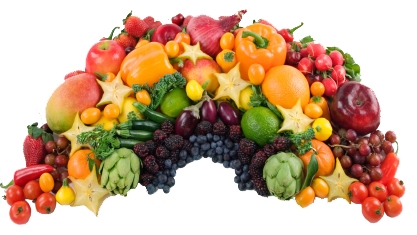
Not what most people think of when they hear "taste the rainbow."

Not what most people think of when they hear “taste the rainbow.”

The different colors of different foods help you to determine the nutrient and phytochemical content of the food.  (Source)  Red fruits and vegetables contain Lycopene (as well as countless other nutrients and chemicals), a powerful compound that might have an effect on reducing the incidence of certain cancers. (Source 1, Source 2)  That’s just one example.  There are many different compounds derived from all of the different colors; you can read more about it here.

It sounds like you’re only talking about healthy stuff. . .

When it comes to flexible dieting, there is definitely room for foods that aren’t necessarily nutrient dense–  That’s the whole point of it.  Rather than leave any food off limits, you make room for it.  Here’s something else to keep in mind, though:  Just because a food is more enjoyable, doesn’t mean you can’t think of the health benefits.  Take dark chocolate for example–  It’s packed full of vitamins, minerals, fiber, and phytochemicals.  (Source)  Does this mean you should eat 300 Calories worth of chocolate each day?  Not necessarily, but it also means that foods you may typically associate with being a “Free Food” (One that may not be that nutritious) isn’t always devoid of health benefits.  In fact, while there are foods / beverages that are nearly devoid of nutrition (chips and sodas), most foods have some nutritive value.

Is there a “wrong way” to do Flexible Dieting?

Here’s what I advise people do–  When tracking your nutrition, be sure to track your fiber intake from non supplemental sources.  If your fiber intake is adequate, the chances are, you’re making smart choices in your food, since you’ll be consuming a variety of whole grains, fruits, vegetables, nuts, legumes, etc.  So how much fiber do you need in a day?  (Source)

  • Fiber needs for Men: 38g / Day
  • Fiber needs for Women: 25g / Day

It’s also worth noting that, if your goals include fat loss, you’ll likely be eating in a Calorie deficit–  By choosing more nutrient dense, high fiber foods, you can help keep yourself full since fiber helps with satiety, and you can typically consume higher amounts of nutrient dense foods.  Don’t believe me?  Weigh out 100 Calories of Broccoli vs. 100 Calories of Chips, and tell me which food has more volume.

There is another way to do flexible dieting wrong, and that is the obsession with trying to eat a “perfect” diet.

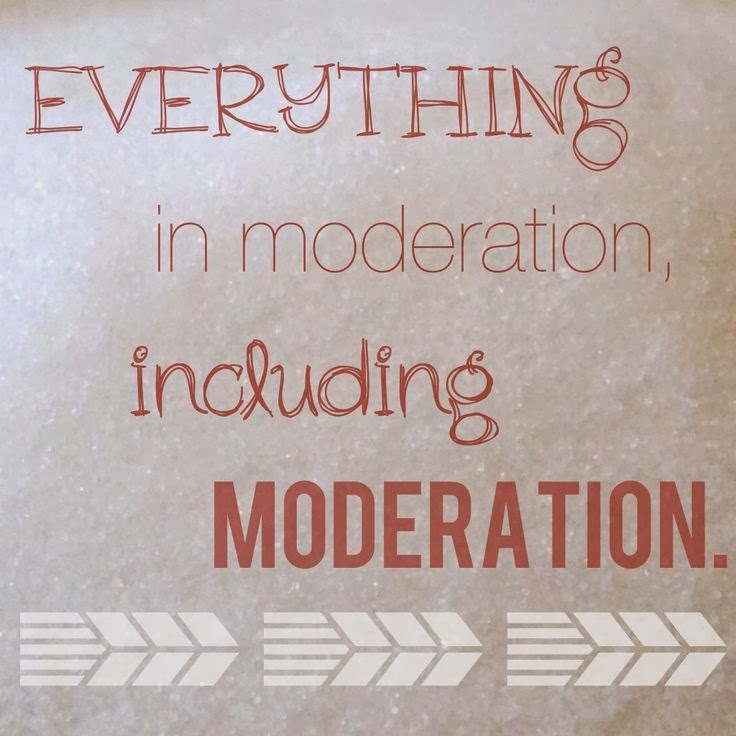
There is no perfect diet; and remember that even an obsession with healthfulness can lead to a disordered eating pattern known as “Orthorexia.”  That’s why, as much as I love maximizing the healthfulness of my food, I eat ice cream, animal crackers, pancakes, chocolate truffles, See’s Bordeaux Eggs, and other less than nutritive foods on a daily basis–  I want to eat them, so why restrict myself?  Remember:
Words to live by.

Words to live by.

Plus, ice cream is a dairy source, right?  =)

What I recommend everyone do:  Leave between 10 and 20% of your Calories for the so called “free foods.”  At the same time, when selecting the foods for the rest of your diet, select options you enjoy!  This will help create a great relationship with your healthful nutrition plan!

Flexible Dieting / IIFYM (Part 3) – “Non Restrictive Dieting”

Welcome to Part 3 in my series on Flexible Dieting / IIFYM.  In part 1, we learned that where your Calories come from isn’t important since all proteins, fats, and carbohydrates, regardless of source, will be digested into the same thing; in part 2, we discussed what a Calorie is (just a unit of energy).  In part 3, which will be very a relatively short post, we’re going to talk about one of the most important principals regarding flexible dieting:  “Non Restrictive Dieting.”

How can a “Diet” be Non Restrictive?

I had a client once tell me that the nutrition plans I recommend are still restrictive because you have to restrict your Calorie intake.

When I (and others) talk about flexible dieting, “Non Restrictive” refers to food choices; not Calories.  No matter what, if you want to lose weight, you have to lower your energy intake–  That’s a characteristic of any weight loss plan.  (Source)  In fact, when it comes down to it, when it comes to Calories, every nutrition plan is restrictive in some way–  If you want to maintain your weight, you have to “restrict” yourself to eat at maintenance; if you want to gain muscle, you have to “restrict” yourself to eat only a certain amount above maintenance, otherwise you could gain a much higher amount of fat.

Non restrictive dieting is about choices, and following a non restrictive diet just makes it easier to maintain and more enjoyable.  Quite often, I tell my clients about some of the food choices I make, because it’s the easiest way to demonstrate how non restrictive diets work.  On a regular basis (while dieting down for a bodybuilding show), I eat chocolate truffles, ice cream, ice cream bars, cookies, baklava, etc.

Pictured: Diet food.

Pictured: Diet food.

How do you do that and lose weight!?

Remember to our last posts:  What is most important is that I stay within my Calories (which I do every day); and my body can’t tell if the sugars I consumed came from a banana or a cookie.  I’m in a net energy deficit, which means I will lose fat.

So I can eat nothing but ice cream and pop tarts to lose weight!?

Remember the story of the nutrition scientist that basically did that?  If we’re talking about weight loss, then yes, you really can eat whatever you want since weight loss is dependent on energy balance.  However, that could lead to setbacks in your goals, health, and just general misery:

  • If all of  you eat are “empty Calories,” you’ll likely go over your Calories since these don’t have a very profound effect on satiety.
  • Similar to the above, if you live off of “empty Calories” and manage to stay within your Calories, you will likely spend the vast majority of your day starving.
  • By avoiding nutrient dense foods in favor of pastries and desserts, you risk not only becoming deficient in a number of micronutrients (vitamins & minerals), but you also miss out on valuable phytochemicals that may offer some great health benefits.  (Source 1, Source 2)

So what’s the point, then?

Non restrictive dieting seeks to make dieting more enjoyable, and also offers some psychological benefits:

  • Dieting is more enjoyable because you can make food choices you enjoy–  Rather than cutting out rice, pasta, or sweets, you can make room for them so that you can have them while pursuing your goals.
  • Non restrictive dieting helps to avoid eating disorders like binge eating disorder.  By allowing yourself the freedom to have desserts, you don’t run the risk of falling into a binge each time you eat them since there is no time period where you’re not allowed to have them.  Side note:  This is something I am still recovering from personally, and flexible dieting has made recovery more manageable.  (More information on Binge Eating Disorder)
  • Non restrictive dieting creates a healthier relationship with food.  By thinking about foods in terms of energy, nutrition, and enjoyment, rather than what is “good” and “bad” (or what you “can” and “can’t” do / have), you have more freedom!  You can go out and enjoy a meal with friends while dieting; if you need to change your foods around to better suit your schedule or social life, you can; etc.

You’ll hear a lot of flexible dieting proponents talk about a “healthy relationship with food,” because it’s a very important thing to have.  A bad relationship leads to psychological disorders, weight management issues, and more. (Source: Psychology Today – “How Do I Improve My Relationship with Food?”)

It’s important to note, though, that there is a way to approach flexible dieting that can be not as efficient as other ways–  Thus far, we’ve only looked at flexible dieting from a weight loss perspective.  While that’s a big part of the puzzle, we’re also interested in maximizing the diets healthfulness, and effectiveness. . .

Which is what we’ll be talking about next week–  Healthfulness, food choice, and variety!

Bonus Round:  Here’s a short quiz to evaluate whether you have a healthy relationship with food.  Even though I’m on a contest prep right now with the goal of getting my body fat as low as possible, I scored as having a healthy relationship with food!

Recent Blog Posts