Follow us on Facebook for Training Tips
Physique Coaching Tips from Twitter
DeVine Physiques on Yelp!

Beware of “0 Calorie” options that aren’t 0 Calorie!

If you’re interested in living healthier, or losing fat, you’ve likely shopped for items that are have a Calorie count of 0–  Whether it be cooking sprays, flavored beverages, or any number of other items. You’re not alone–  I am a huge fan of items that are 0 Calorie, but there’s something that everyone should be aware of when it comes to these options. They rarely contain 0 Calories.

Whaaaaaaaaaaat?

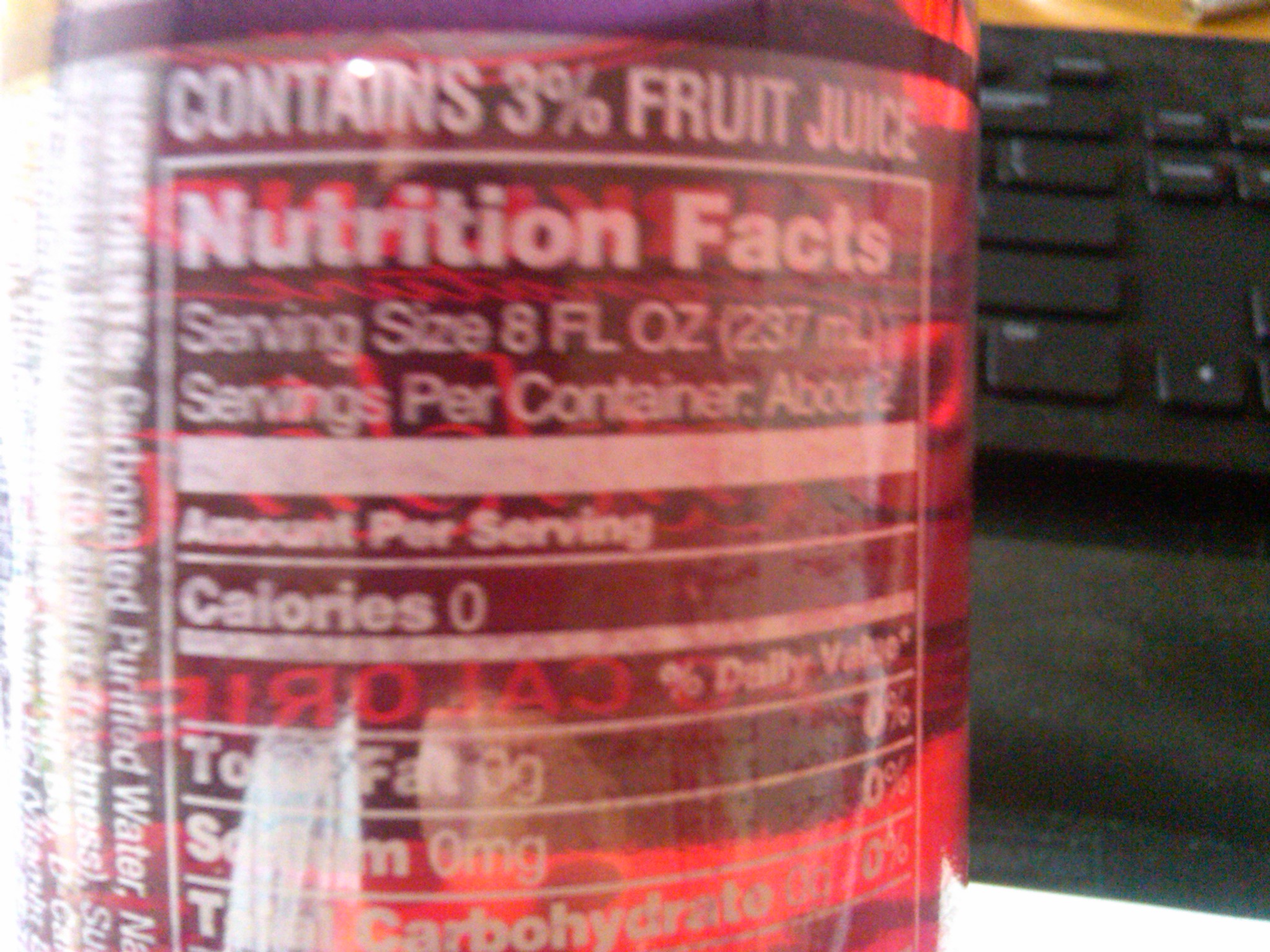
Yes.  It’s true.  To demonstrate, we’ll take this sparkling flavored water as an example.
IMG-20140518-00523

Notice how it says there are  0 Calories.  Notice how it says there are 0g carbohydrates.  Notice how it also says that it contains 3% fruit juice.  If fruit juice is sugar, and sugar is Calories, then how can this drink have 0 Calories?

Simple.  The regulations regarding labeling state that a product may be “Calorie free” if it contains less than 5 calories per “Reference Amount Customarily Consumed” (RACC).

Well, that’s just 5 Calories!  So what?

Now let’s throw out a hypothetical situation–  Let’s say this whole bottle contains 9.8 Calories, right?  That would mean that they have to list the Calories, right? Not so fast. . .
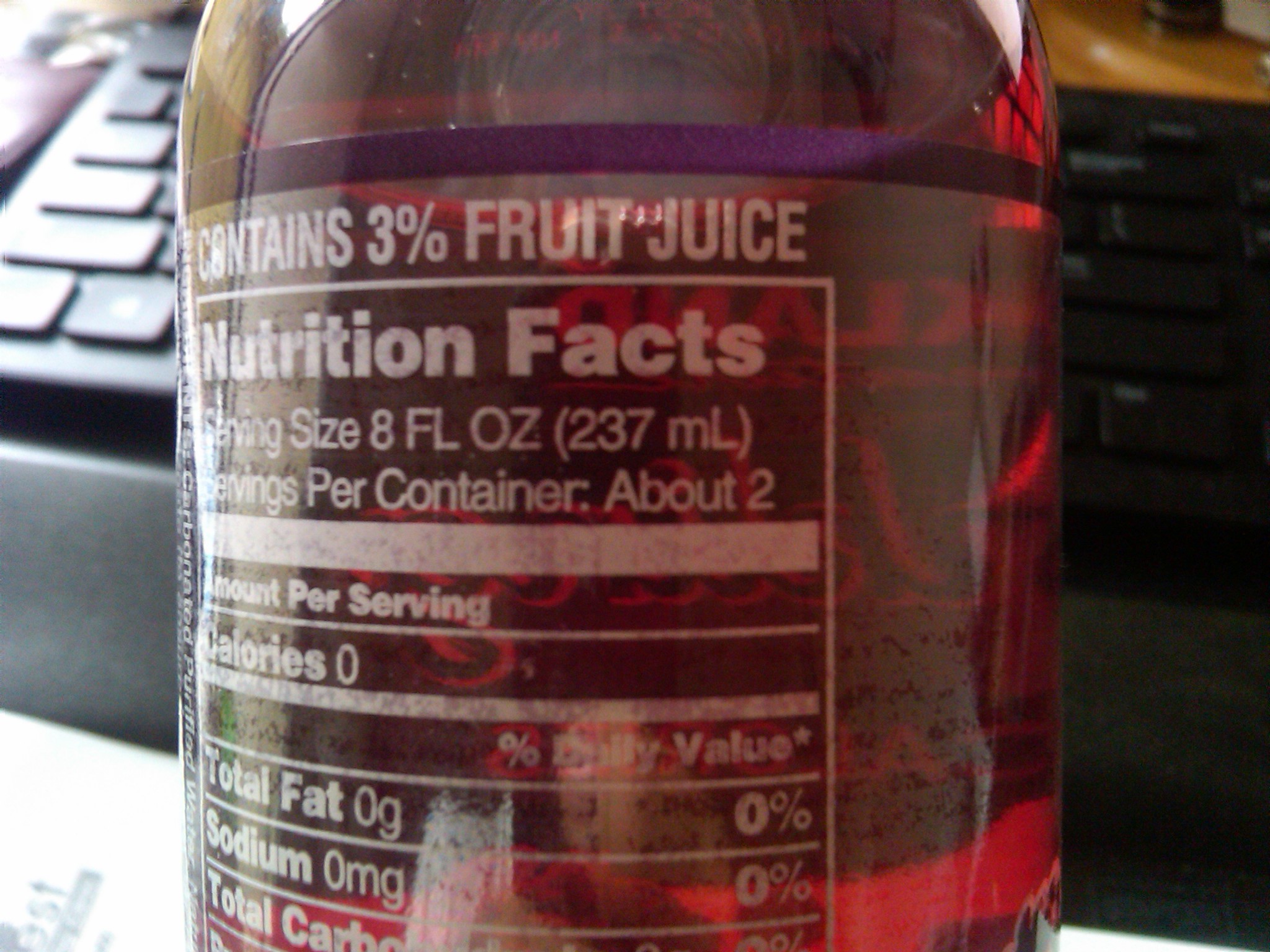
"About 2 Servings."  Or 2.06 to be exact.

“About 2 Servings.” Or 2.06 to be exact.

The RACC for drinks is typically 8 fl. oz., which means there are just over 2 servings in this 17 fl. oz. bottle, which means this drink could contain up to 10 Calories.

Well that’s just 10 Calories!  So what!?

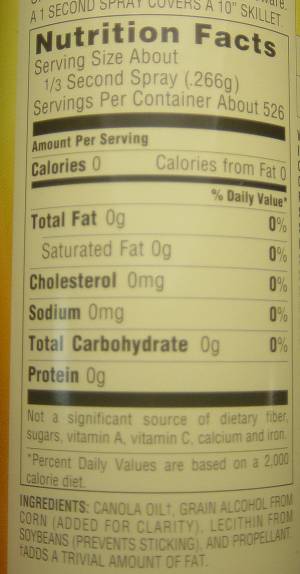
Do you use cooking spray?
Oil contains no  Calories?

Oil contains 0 Calories?

Do you make sure that your spray lasts less than 1/3 of a second so that you’re getting less than 5 calories of oil?  Let’s say you spray pretty liberally, and use it during two meals–  You could be consuming anywhere from 20 – 40 calories from fat.

Well that’s just a few extra Calories!  So what!?

Let’s put this all together–  Let’s say you drink two of those flavored waters, use cooking spray liberally, chew non sugar free gum, etc.  All of these things, under the guise of 0 Calorie, contribute Calories–  Maybe even as much as 100 per day if consumed in sufficient volumes. Let’s say your deficit is -500 Kcal / day.  Now your deficit is only -400 Kcal / day–  That means instead of losing a pound per week, you’ll be losing 4/5 lb. per week.  It all adds up.

So what should I do?

My recommendation is to be mindful of these foods in your diet–  There’s nothing wrong with consuming them, and if you use them (very) sparingly, don’t worry about it. However, if you consume multiple items that could contain hidden calories, I would do my best to try and come in just below your Calorie goals to account for it.

As an example, if the only hidden Calories in my day are from my cooking spray, I don’t bother with it.  If, however, I also drank some of those 0 Calorie drinks, and used cooking spray, I will choose to end my day 20 Calories below my target; this is done, of course, because I’m preparing for a contest and need to be as accurate as possible. . .

This may be a little extreme for you, but for best results, you must be as accurate as possible.
Sources and Links

Planning / Tracking Your Meals

I would argue the most important part of any positive lifestyle change (Which includes physique goals, weight loss goals, health goals, etc.) is nutrition–  I know I’m not alone in that.

The question is, though, how do you plan your meals?  Well, it’s really not that difficult once you get the hang of it–  The key is to plan, while simultaneously tracking, rather than simply tracking.

Planning / Tracking vs. Tracking – What’s the difference?

If you only track your food, that means you track is while you eat, and at the end of the day, your macronutrients (Protein, Carbs, Fats) may be way off, and you may overshoot (or undershoot) your Calorie goals

I’m going to share with you how I plan (and track) my meals daily, and hopefully this will help shed some light on how to plan your own day so you can achieve your goals!

Let’s get started!

Typically, I plan my day the night before–  Though there are times where that’s not practical, so I plan them the next morning as soon as I wake up.  Here’s an important note:  I always have my day planned out before I start eating anything.  This way I can make sure I hit my macros for the day and haven’t sabotaged myself.

When I start planning, I start with my high protein meals first (Which for me is every meal), so that I ensure my goal for the most important macronutrient is met.

(There’s a lot more that goes into my planning, of course, like getting a variety of foods so I get a broad range of phytochemicals, and other such things, but this is just a basic idea.)

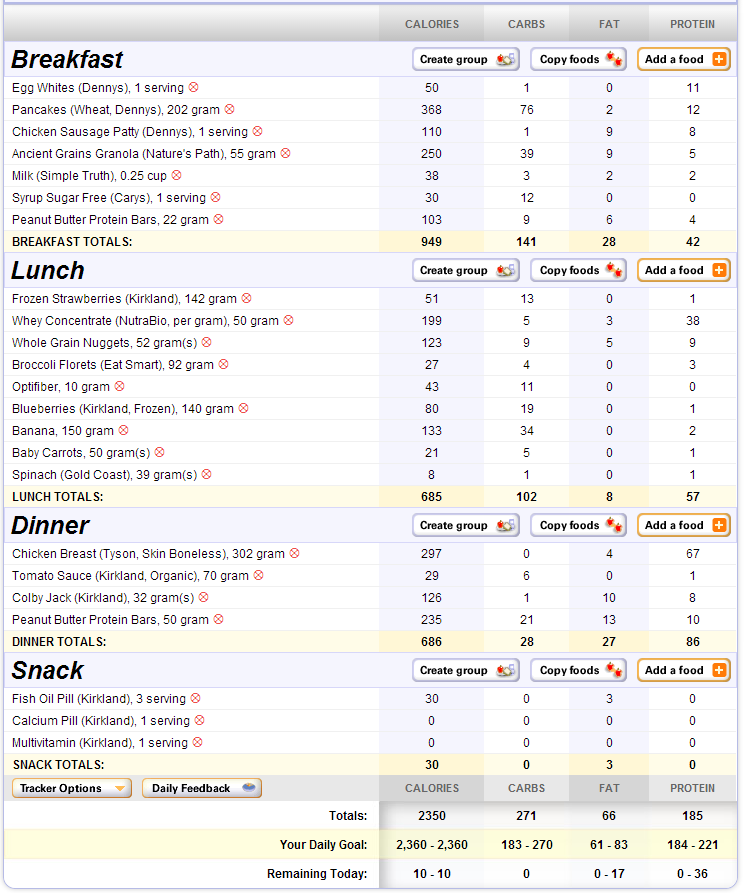
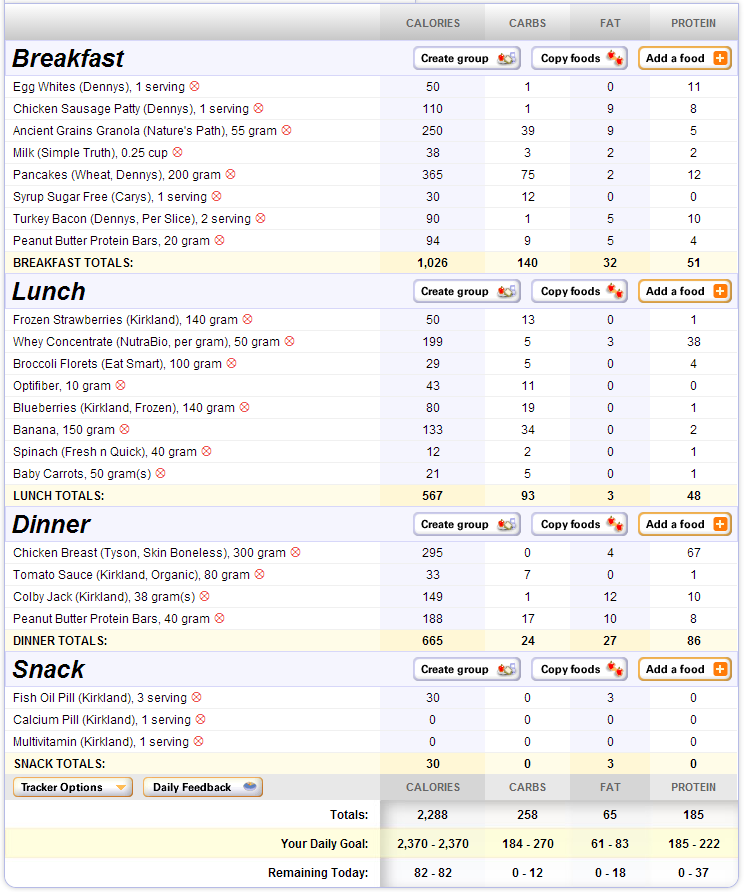
So now, I’ve been awake for about 15 minutes, and here’s what my tracker looks like:

blog1

Now, for those who have some level of experience tracking their food, you may say: “How do you know that the banana you have is going to weigh 150g?”  “How do you know that your pancakes at Denny’s will weigh 200g?”

The answer to that:  I don’t.  I put in placeholder values for all of these items, and then I update them throughout the day–  In a lot of cases it will be close to the mark, but there are times where there are drastic differences.  This is also why I tend to keep some calories open for the end of my day.

As I go throughout my day, I update the values as they’re measured.  At Denny’s, a serving of pancakes is 170g, and contains 310 Kcal.  Of course, their pancakes are never made to a serving size, and always go over, which is why I not only anticipate that in my tracker:

blog3

. . .  But I also bring a food scale to Denny’s with me to measure.

Why would you do that!?

The largest variance in serving size I’ve experienced at Denny’s was 62g–  That means that someone who looks at the nutrition facts but doesn’t measure them thinks they’re consuming 310 Calories, but really, they’re eating 423 Calories.  (Even on the day I’m showing you the pancakes were 32g more than a serving, which is an extra 58 Calories over a serving.)  As an example: If you get nutritional counseling from me, I typically set up a 400 Kcal daily deficit, which is slightly less than 1 pound per week of fat loss;  if you went to Denny’s and had those pancakes one day, your deficit would only be 287 Kcal–  And that’s only from one food having a massive variance.  Just imagine if other foods had such variances.  Would you even be eating in a deficit?  This is why you track.

The rest of the day should be tracked similarly–  Update the foods you consume with the accurate measurements as you’re prepare and consume them.  As an example, my Massive Fruit & Veggie Smoothie has a lot of placeholder values added at the start of the day–  When I prepare it, I just leave the blender on the food scale while I measure every ingredient.

By the end of the day, I’ve updated everything, made revisions, and my day looks like this:

blog2

And this is why I see results at the rate I should see them.  While you can never track your calories with 100% certainty, you can get as close as possible, which I feel I do on a daily basis.  The more accurate you are with your tracking, the quicker you will achieve your goals!

Recent Blog Posts