

Shoulders and Training Splits
If you do a full body workout, this post isn’t really for you. Of course, it’s always worth reading for the knowledge, but we’re going to discuss where shoulders go when you’re doing a split routine. So, where to begin?
I’m doing full body workouts– Should I split it up?
Split routines are great for trained individuals, but not for those starting out– In your first year or two of training, you will see tremendous results from a full body workout, and there’s no reason to stunt this growth by prematurely switching to a split routine– Of course, once your progress begins to slow, or stagnate, then it is time to switch over to a split.
Popular Splits
There are many ways to split your workout– You have a 2 day split where you train your upper body on one day, and your lower the next– This method can be used to train 2 or 4 days per week. In a similar vein, you can do a 2 day split where you train back, biceps and legs one day; and chest, shoulders and triceps the next. When I do a two day split, that’s how I do it. The next would be a 3 day split, where you do legs one day, and then do a “push / pull” split the next two days where you train shoulders, chest and triceps on one day; back and biceps the next. This method can be used to train 3 to 6 days per week. (It’s worth noting that I employ this style of split and am currently training 6 days per week. I like it because it employs a very important tenant behind training: Think about muscles in terms of movements, rather than groups.)
There are other splits, too, like a 3 day where you day legs one day, torso the next (Back / Chest), and shoulders and arms the final day. A four day, where you do legs one day; back and biceps the next; chest and triceps the next; and shoulders the final day. Then you have a five day split where you do legs, then back, then chest, then shoulders, then arms.
There are a lot of ways to do it, and it’s ultimately up to you (and your trainer, if you have one) to determine what would be best for your goals.
So why do you have “Shoulders” in the title of this post?
Shoulders are a tricky muscle group. There are three heads to your “Deltoid:” The anterior (front), medial (middle), and posterior (rear) heads; each one has it’s own function.
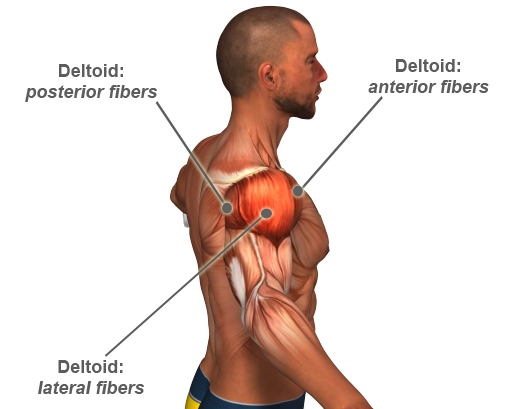
Meet the deltoids!
Usually, the medial deltoid is a synergist (“Helper”) to the anterior deltoid; the anterior deltoid is also often a synergist to movements involving the pecs. By this logic, I would make the case for not having a “shoulder day,” and instead, training shoulders with your chest– Otherwise, your shoulders may not have enough time to recover, and you may not see the gains you want. This can be seen on a “Legs / Torso / Shoulders & Arms” split, where your shoulders would end up seeing action two of those days, and if you train 6 days a week, then they would be used 4 days– Not enough time to recover = losing gains = no bueno.
You forgot to mention the “Posterior Deltoid.”
I didn’t forget. The posterior deltoid is involved in different movements than the medial and anterior deltoids, and thus, I would not include it in a “shoulder day.” In most rowing movements, and / or back exercises, your posterior deltoid acts as a synergist. Also, in movements where the posterior deltoid is the agonist (“Prime Mover” or “Target”), many different back muscles act as the synergist– Which is why your posterior deltoid, when doing a training split, should actually be trained with your back muscles.
Think about it– If you train all three heads of your deltoid on your chest day (Where shoulders belong on a three day split), that means you’re also working your back on your chest day– And if you do each body part twice a week, that would make four days that you’re training your back; not enough time for recovery if you want to see gains!
That makes sense.
Training splits can be valuable, but understand that part of the reason for doing a split is to give your muscles enough time to recover– That’s why it’s often important to think of your muscles in terms of movements, rather than groups. Putting all shoulder movements together is not ideal, since you’re then combining movements, which defeats the purpose of doing a training split.