Follow us on Facebook for Training Tips
Physique Coaching Tips from Twitter
DeVine Physiques on Yelp!

Archive for the ‘Body Building’ Category:

Training Related Footwear– What should you wear?

I’ve had many clients ask what is appropriate footwear to wear in the gym–  I’ve also had a majority of my clients that never ask at all, and don’t give much thought to it.

At the end of the day, though, what should you wear?  The answer:  It varies.

Cardiorespiratory Training – Running Shoes

Running Shoes

This one is probably a bit obvious, but it’s worth mentioning.  Running shoes should be worn when performing cardio related activities, and could also be considered when performing cardio related activities like plyometrics (“MetCon”).  Running shoes offer a lot in the way of support and shock absorption, but this makes them a less than stellar choice for weight lifting, as it’s not a stable base (in comparison to other shoes).

Plyometrics / MetCon – Training Shoes

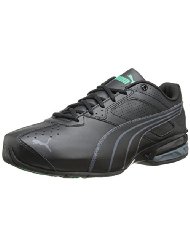
Crosstrainer Shoes

Running and Training shoes vary in a variety of ways, but a lot of people view them as the same sort of shoe.  Running shoes tend to be a very lightweight material that is meant to bend and flex, while training shoes tend to be a bit heavier, composed of leather (or synthetic leather) that keeps shape better.  This is useful in MetCon because it helps keep your foot stable during the movements; especially lateral movements where the foot can shift around in the shoe.  Even though they’re more rigid than running shoes, they do offer a level of shock absorption and support that other styles of shoes may not offer.  If you’re only going to buy one shoe for all of your activities, this would be the one to go with, as it can serve many purposes.

Olympic Weightlifting – Weightlifting shoes

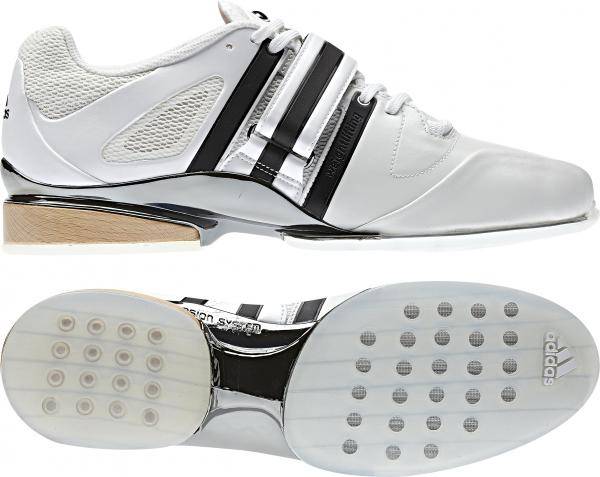
Olympic Weightlifting Shoes

Olympic Weightlifting Shoes

Weightlifting shoes are very specific–  They’re rigid, relatively heavy (depending on the style), and have a slightly raised heel that helps keep your ankle in a dorsiflexed position; this in turn helps you to maintain proper form during specific parts of the Olympic lifts.

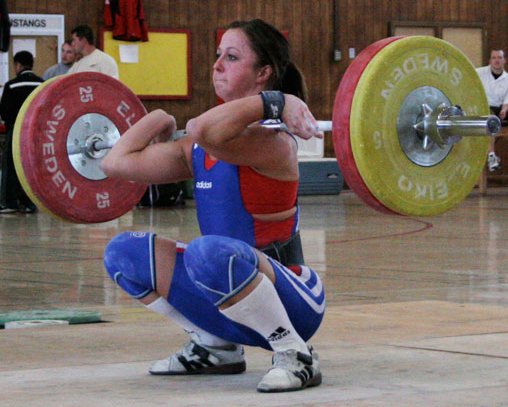
Weightlifting Shoes assisting the Clean & Jerk

Weightlifting Shoes: Helping you get ATG.

Weightlifting shoes may also be used for squats, as they provide a stable base, and can assist in hitting proper depth (because of the position is puts your ankle in).

Heavy Weightlifting / Powerlifting – Flat Shoes or Barefoot

For heavy weight lifting, a simple flat shoe is the best option out there.  It doesn’t have to be Chuck Taylors, but these are by far the most popular.  I wear, and recommend Leopard Print.

Leopard Print Chuck Taylor All Stars

The leopard print adds 20 lbs. to my deadlift.

This provides you with a stable base, your foot will always be in the anatomical position, and because the material of the sole is relatively thin, it also keeps you low to the ground.  The alternative to this is barefoot, where instead of there being a flat sole to provide a stable base, there’s the Earth serving the same purpose.

. . .  Except when there’s an earthquake.

Archive for the ‘Body Building’ Category:

Training Related Footwear– What should you wear?

6 years ago I was obese (BMI 32.35) and unhealthy. 5 years ago I was skinny and unhealthy. 4 years ago I started living a healthier lifestyle. 3 years ago I became interested in bodybuilding and lifting weights. 2 years ago I got serious about bodybuilding. 1 year ago I decided I wanted to do a bodybuilding competition. About 1 week ago, I stepped on a stage in a posing suit.

IMG_0431

It’s been a long journey that is far from over, and it’s fun to look back on other aspects of my life and see how they’ve evolved as well.  6 years ago, when I was obese, smoked a pack of cigarettes a day, and drank heavily, had you told me I would eventually become intensely passionate about health & fitness, and would change career paths to help people realize their health & fitness goals, I likely would have laughed.  And lit up a cigarette to spite.

. . .  But that evolution is a part of the journey.  Everyone is obsessed with the quick fix, or how fast they can get something done, but I’m here to tell you that life is not about the destination!  At the risk of getting too heavy for a blog post, if you look at all of our lives as a book, the first chapter starts in the same way, and the last chapter ends in the same way; what differs are the pages in between.

There are many bodybuilders that never step up on stage, instead opting to do “mock preps” so they can talk about preparing for a show without ever being judged.  They’re too scared to not win; they’re too scared they won’t step out on that stage as the winner they see in themselves, and they can’t handle the thought of failure.

. . .  But failure is where you learn from; and where’s the fun in that!?  With no knowledge of competing in bodybuilding, and without ever having seen a show, I decided to get on that stage, because life is about doing, and it’s about the journey.  It’s about what you learn along the way, whether it’s what foods work well for you while dieting, or how your body responds to dieting, or simply that you’re not very good at posing and you need to practice if you ever want to win a competition.

I didn’t win my first show, but that is perfectly okay!  Rather than talk about a goal I had set for myself, I went out and did it; sure, I may not have won, but I went the distance!  I had a blast, I learned a lot, and I can now call myself a natural bodybuilder.

When you’re on the path toward your goals, it’s important to keep your eyes on the goal, but it’s also crucial that you enjoy the ride while you’re getting there.  While my goal is to get my “pro card” as a natural bodybuilder, what’s the point if I don’t enjoy the journey (that could take years) along the way?  Even if your goals will only take a few months to achieve, what do they mean if you’re not enjoying yourself?

That’s why I advocate flexible dieting; that’s why I advocate taking risks; that’s why I advocate living the dream–  It’s important to enjoy the journey!

Archive for the ‘Body Building’ Category:

Training Related Footwear– What should you wear?

When I was young, I wanted to be a scientist–  There was a wide variety of fields I considered, such as paleontology, astronomy, geology, astrophysics, engineering, and others.  At some point along the way, I deviated from my passion for science, and instead pursued the arts.

. . .  Oddly enough, the arts brought me back to my passion for science.  I’m now in school with the eventual goal of a M.S. in Nutritional Science (Possibly a PhD), and I now research all subjects thoroughly so that I have scientific evidence to back up my claims and recommendations.  (You’ll also notice that my blogs started containing sources.)

It’s easy to get sucked into the sort of anti science mindset that is stereo-typically associated with artistic types.  For a while, I was anti GMO, believed in faulty nutritional science, and wrote a lot about pseudo-scientific topics on this blog.  I’ve actually gone back and destroyed that evidence–  I don’t want to contribute misinformation to the Internet.

1921871_808153689213070_315568724_n

While quite a bit went into my rediscovery of my passion for science, there are 5 different moments in particular that had a pretty profound effect on me, and they all happened within a relatively short time period; and that is something I would like to share with you.

“Why are GMOs bad?”

I was against GMOs–  They seemed horrifying!  You see all of these memes shared on Facebook that talk about the different health risks of these “Frankenfoods,” and indeed, if you lack the any knowledge in Biology (or disregard it), GMOs must be stopped.  One day, someone asked me, “Why are GMOs bad?”  I couldn’t think of a reason off the top of my head, and went to Google it.  The strangest thing happened–  I couldn’t find a single credible resource claiming any drawbacks whatsoever (health or otherwise), but found plenty of credible, scientifically based resources proving their safety and efficacy.  I’m not afraid to admit when I’m wrong, and this was a time when I most certainly was.  My position has changed, and I have evidence to back me up.  (Source)

“You know protein causes a spike in insulin, right?”

I spent a lot of time spinning my wheels–  Years, in fact.  I wasn’t able to lose weight no matter what I would do.  For a while, I thought following an extremely low carb diet would work for me, and indeed, I saw an initial result (as everyone does), but that was it.  From reading a myriad of incorrect articles, I thought that restricting carb intake would suppress insulin release, thus turning off my body’s ability to store fat.  This would eventually, hypothetically, lead to ketosis, where my body would “burn fat” for fuel.  All of this was wrong (which I’ll address later), but I had no idea.  I explained this logic to someone on a forum, and someone else asked, “You know that protein causes a spike in insulin, right?”

I immediately started researching, and eventually found a plethora of scientifically based articles proving that person’s point.  (Source 1 & Source 2)

This is very similar to the next–

There are several main reasons that I recommend retaining carbohydrates.”

Dr. Layne Norton (PhD Nutritional Science) is a. . .  I don’t want to say a hero of mine, but I definitely respect him and look up to him.  I trust the information he puts out not only because of his education and experience, but because research backs his advice and recommendations.

That said, he has a fantastic article (more like novella) about preparing for a bodybuilding show, and right off the bat, he talks about the importance of consuming carbohydrates.  At this point in my life, I thought that bodybuilders ate no carbs to prep for a competition, and indeed, I came across this article just around the time I had become enlightened to protein’s effect on insulin.  This completely shook up my world–  For the better!  After reading the article twice through, I started reintroducing carbohydrates into my nutrition plan.  (Source)

Citation Needed

I had started putting a lot more energy into my research; I was also very strict, limiting myself to only reputable resources with adequate research backing it up. . .  I was also adding these resources to the end of my blog posts–  I had begun looking for sources in everything I read, so I wanted to provide those to my readers.  There’s a phenomenon that I used to believe in that basically said if you diet a while, and then have a massive cheat day, your body won’t absorb those Calories because, and I quote, “your body doesn’t know what to do with all that food.”  Someone recommended I write a blog post on that subject, and when doing research, I couldn’t find any evidence to support this claim, but mountains of evidence to the contrary.  In fact, as I’ve learned in my textbook “Nutrition (5th Edition),” the human body can absorb at least kilograms of Carbohydrates, 500g of Fat, and 500g – 700g of Protein.  For a little perspective, that means, at an absolute minimum, your body can absorb at least 10500 Calories a day (but really, is capable of significantly more).  (Source)

It’s worth noting that my notoriously insane, regularly scheduled cheat meals also helped me not lose weight.

Beta – Oxidation

The final event–  my complete turn to the right side of The Force, came when I was studying the textbook for my NASM certification.  The book is very science heavy (as it should be), delving into physiological topics such as biomechanics, bioenergetics, anatomy, metabolism, and much more.  The book details beta-oxidation, a dominant metabolic pathway, and one that is lipolytic (fat burning).  All that work to convert my body to “burn fat for fuel” by not eating carbs, and my body already did it daily.  (Source 1 & Source 2)

“Zealot”

What was even more amusing is that, in addition to these instances, my first science class after returning to school managed to break down all of the remaining pseudo-scientific myths that I hadn’t yet let go of.

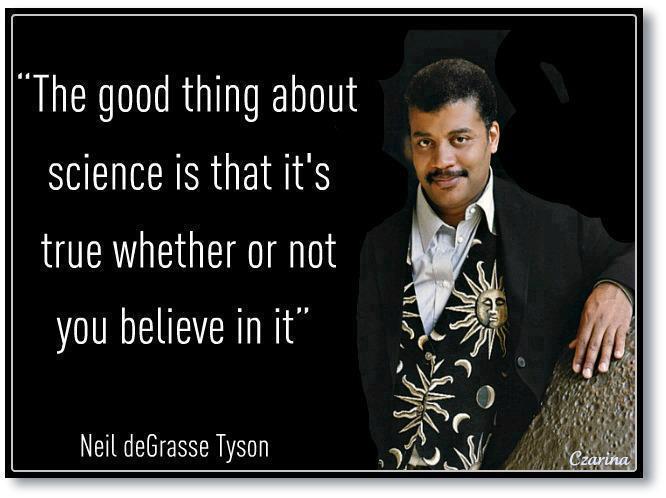
I am now so pro science that I would almost classify myself as a zealot; but I mean that in the best possible way.  If you don’t trust in science, what can you trust?  What can you believe?  If you reject science, do you think the Earth is flat?  Do you believe in the geocentric model of the Universe?  I know that’s a bit of a “Slippery Slope Fallacy,” but I maintain that it’s a fair argument–  How do you choose what science to reject and what to “believe”?  Science has done so much for humanity, continues to do so, and I want to contribute to that; I want to help spread the word, and help people achieve their goals!  Remember:
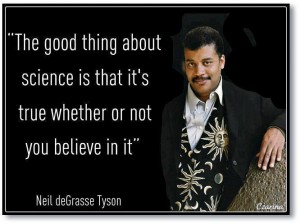
Preach it!

Preach it!

Archive for the ‘Body Building’ Category:

Training Related Footwear– What should you wear?

I measure everything I eat–  Unless it’s something packaged, processed, and sold by weight where I know how much each individual item is, it gets weighed on my food scale.  Actually, even some of those items get weighed.

I had a client ask my how much of my day is spent weighing my food, so I set out on an experiment–  I also made a video about it:

To answer the question: 10.5 minutes total.  Such a small part of my day is devoted to measuring, and that 10.5 minutes isn’t even all at once–  That’s spread out throughout the day.  It works out to 0.73% of your day.  If you think of your day like a dollar bill, that means that less than a penny is “spent” on measuring my food for my goals.

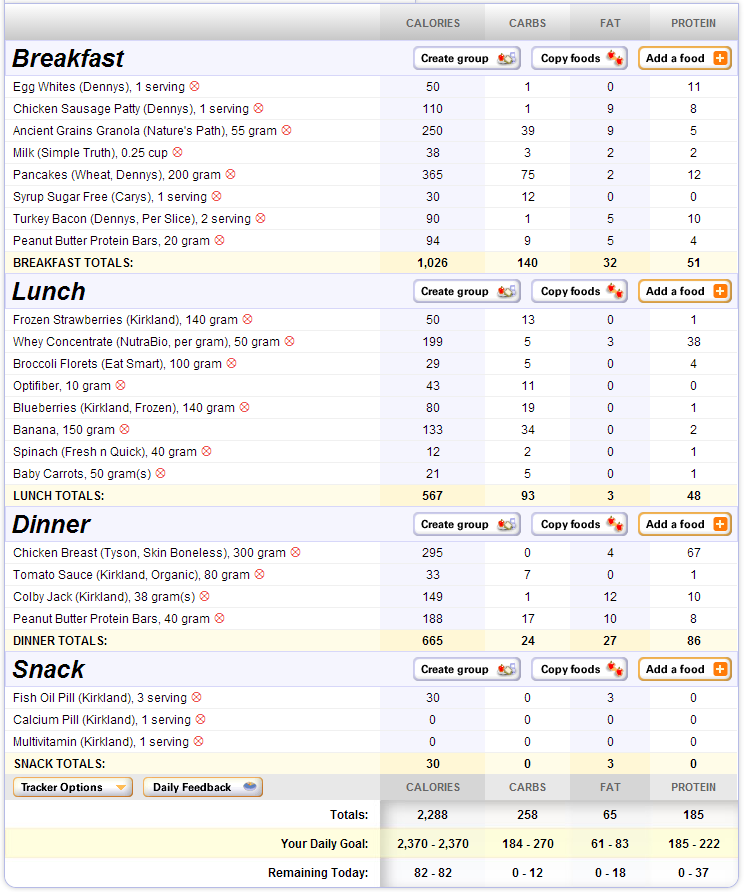
Something else I would like to discuss (that isn’t in the video) is what my day looks like when it’s planned vs. how it ends up–  It evolves quite a bit as I update everything as it’s measured.  Here’s my tracker at the start of the day:

VlogStart1

There’s a lot of food there, so my final stats got cut off, but it ended up at 2,261 Calories; 273g Carbs; 54g Fat; 192g Protein.  Here’s how my tracker looked at the end of the day:

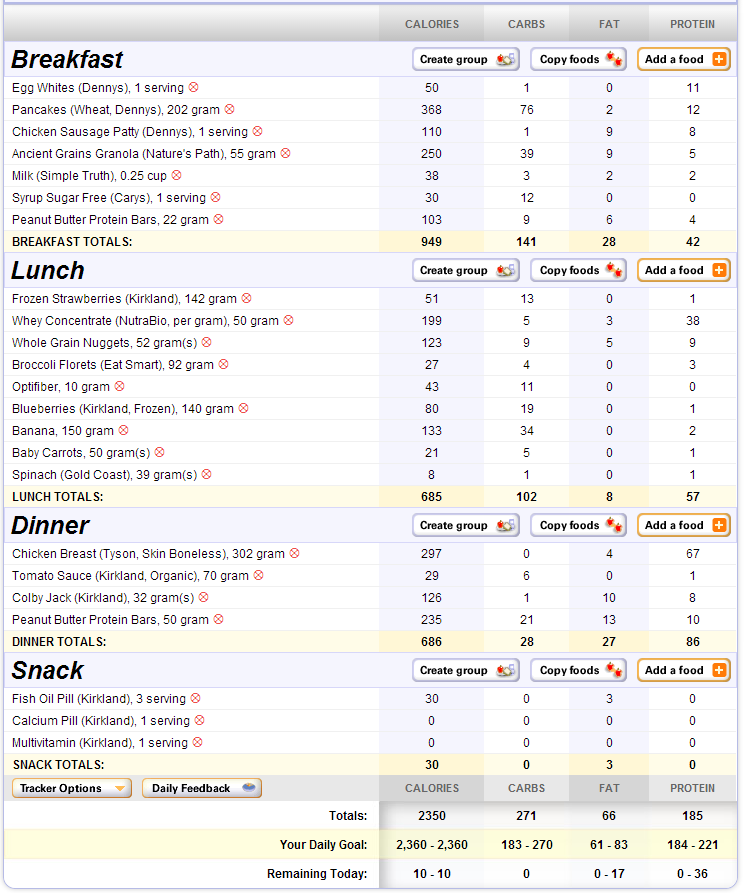
VlogFinish

I finished my day at these totals: 2,326 Calories; 280g Carbs; 60g Fat; and 188g Protein.  I was within my macro ranges, and came in just below my Calorie needs.

Archive for the ‘Body Building’ Category:

Training Related Footwear– What should you wear?

I was sent an Email this morning about a miracle weight loss supplement featured on Dr. Oz.  First, let me say I later found out the Email was sent from an Email that was hacked.  Second:

Dr. Oz is entertainment.  He’s a surgeon, not a scientist; but more than that, he’s an entertainer whose goal is to increase viewership and ratings so that the network may sell advertising space at a premium.  He’s been called out by Popular Science, and other organizations for giving non scientific advice.  His show is chock full of pseudoscience, and he was even given an award to recognize his “extraordinary contributions to America’s scientific illiteracy and pervasive fear mongering.”

Dr. Oz Quackery

You’re a “doctor” yet you believe in magic?

Anytime someone says they saw something on Dr. Oz, I am immediately skeptical.

This post isn’t about Dr. Oz, though. . .  It’s about fat burners and what you should consider before buying.

Let’s start with the claims of the supplement–  It will “melt fat away.”

Well I want my fat to melt away!

Here’s the thing about any weight loss supplement–  It’s meant to supplement an effective weight loss plan.  If you eat whatever you want and your Calories are way above maintenance, no legal (or safe) supplement can burn off the amount of Calories necessary for you to burn fat.

But there’s a study about it!

Hah!  “Study.”  True. . .  In the initial article, there was this link:

Dr. Oz Fat Burner

If only it existed. . .

Unfortunately, when you click to view the study, it takes you to an online order form with no study in site.  In fact, there is no way to actually find the study they claim proves it’s effectiveness, but I did keep running into clips from Dr. Oz.

This is why I advise all clients to check with me before buying supplements–  There is an entire world of effective supplements out there than will help you toward your goals, but it takes a bit of education when deciding what to buy.

But people lost weight with it!

True, and it’s possible for a supplement to enhance your weight loss–  There are a lot of effective fat burners, thermogenic compounds, etc., but let’s look at the numbers for a second to see how these work.  Let’s say you want to lose fat:

Option #1: You’re completely sedentary, and you don’t watch what you eat.  Without realizing it, you’re currently eating 200 Calories above maintenance, which means you’re steadily gaining 0.4 lbs. per week.  You take a fat loss supplement that raises your energy needs by 150 Calories per day, but since you don’t track anything, you don’t realize that you’re still eating above maintenance.  While this will slow your fat gain, it doesn’t create a situation where you’re losing, or even maintaining.  Instead of gaining 0.4 lbs. per week, you’re now only gaining 0.1 lbs. per week.

Option #2: Through your nutrition and training you’re currently maintaining your weight because you’re struggling with your nutrition plan.  So you take a fat loss supplement–  This raises your energy needs by 150 Calories per day–  That means that now you could lose 0.30 lbs. per week.

Option #3Through your nutrition and training, you’re currently losing 0.5 lbs. per week because you’re very good at maintaining a deficit of 250 Calories per day.  As happy as you are with your fat loss, you want to lose weight faster, but don’t want to consume less food.  You take this fat loss supplement, which raises your energy needs by 150 Calories.  This means that your daily deficit is actually 400 Calories per day, which leads to 0.8 lbs. of fat loss per week.

The stories you hear about in the testimonial section of these websites are from those in the “Option #3” camp. . .  They already have a grasp on their nutrition and exercise, and are using the supplements to enhance their results.

Need more proof?  Here’s the fine print from the website: “Actual weight loss will vary and in many cases will not be typical. . . […] Each person’s experience will depend on the reasonableness of their weight loss goal, the time they allow themselves to lose the weight to attain their weight loss goal, their age, state of health, their diet and exercise and any limitations placed on them by their health care professional due to the above or any other factor.

I added the bold for emphasis.

So what’s the truth about this supplement?

I won’t link to the website from the Email I got for two reasons:

  1. I don’t want to give them any traffic since they’re not only deceptive, but they’re also promoting through Email hacking.
  2. They’re not a supplement manufacturer that I trust.

The supplement itself can be an effective tool for fat loss.  Looking it up on Examine.com shows that there is evidence to support the claims made (even though more studies are needed).  I just recommend buying it from a trustworthy company, consulting someone familiar with the topic (Trainer, Coach, Doctor, etc.), and understanding the role a supplement plays in your plan.

What supplements are in your cupboard?

It’s worth noting that this post may make it seem like I’m on the fence about fat burners and supplements.

I’m not against supplements–  In fact, I’m all for them!  There are fat burners in my supplement cabinet, and before doing cardiorespiratory training, I take a mild fat burner “stack.”  What matters, though, is that my nutrition and training is 100% dialed in, and I use supplements to enhance my results.

The key is to remember what the point of a “supplement” is; it’s to supplement a healthy nutrition and training plan.

Archive for the ‘Body Building’ Category:

Training Related Footwear– What should you wear?

I would argue the most important part of any positive lifestyle change (Which includes physique goals, weight loss goals, health goals, etc.) is nutrition–  I know I’m not alone in that.

The question is, though, how do you plan your meals?  Well, it’s really not that difficult once you get the hang of it–  The key is to plan, while simultaneously tracking, rather than simply tracking.

Planning / Tracking vs. Tracking – What’s the difference?

If you only track your food, that means you track is while you eat, and at the end of the day, your macronutrients (Protein, Carbs, Fats) may be way off, and you may overshoot (or undershoot) your Calorie goals

I’m going to share with you how I plan (and track) my meals daily, and hopefully this will help shed some light on how to plan your own day so you can achieve your goals!

Let’s get started!

Typically, I plan my day the night before–  Though there are times where that’s not practical, so I plan them the next morning as soon as I wake up.  Here’s an important note:  I always have my day planned out before I start eating anything.  This way I can make sure I hit my macros for the day and haven’t sabotaged myself.

When I start planning, I start with my high protein meals first (Which for me is every meal), so that I ensure my goal for the most important macronutrient is met.

(There’s a lot more that goes into my planning, of course, like getting a variety of foods so I get a broad range of phytochemicals, and other such things, but this is just a basic idea.)

So now, I’ve been awake for about 15 minutes, and here’s what my tracker looks like:

blog1

Now, for those who have some level of experience tracking their food, you may say: “How do you know that the banana you have is going to weigh 150g?”  “How do you know that your pancakes at Denny’s will weigh 200g?”

The answer to that:  I don’t.  I put in placeholder values for all of these items, and then I update them throughout the day–  In a lot of cases it will be close to the mark, but there are times where there are drastic differences.  This is also why I tend to keep some calories open for the end of my day.

As I go throughout my day, I update the values as they’re measured.  At Denny’s, a serving of pancakes is 170g, and contains 310 Kcal.  Of course, their pancakes are never made to a serving size, and always go over, which is why I not only anticipate that in my tracker:

blog3

. . .  But I also bring a food scale to Denny’s with me to measure.

Why would you do that!?

The largest variance in serving size I’ve experienced at Denny’s was 62g–  That means that someone who looks at the nutrition facts but doesn’t measure them thinks they’re consuming 310 Calories, but really, they’re eating 423 Calories.  (Even on the day I’m showing you the pancakes were 32g more than a serving, which is an extra 58 Calories over a serving.)  As an example: If you get nutritional counseling from me, I typically set up a 400 Kcal daily deficit, which is slightly less than 1 pound per week of fat loss;  if you went to Denny’s and had those pancakes one day, your deficit would only be 287 Kcal–  And that’s only from one food having a massive variance.  Just imagine if other foods had such variances.  Would you even be eating in a deficit?  This is why you track.

The rest of the day should be tracked similarly–  Update the foods you consume with the accurate measurements as you’re prepare and consume them.  As an example, my Massive Fruit & Veggie Smoothie has a lot of placeholder values added at the start of the day–  When I prepare it, I just leave the blender on the food scale while I measure every ingredient.

By the end of the day, I’ve updated everything, made revisions, and my day looks like this:

blog2

And this is why I see results at the rate I should see them.  While you can never track your calories with 100% certainty, you can get as close as possible, which I feel I do on a daily basis.  The more accurate you are with your tracking, the quicker you will achieve your goals!

Archive for the ‘Body Building’ Category:

Training Related Footwear– What should you wear?

I was recently reading the comment section of an article, when I came across a particular gem that just. . .  It actually gave me a headache.  I won’t attribute this to the author, nor will I link the article, but I wanted to take a moment to dissect this comment  (The rant about the government was deleted because it’s not necessary):

“Your understanding is flawed. Obese Americans are not obese due to their caloric intake, it is the vast amounts of processed carbs and simple sugars. They spike our blood sugar and cause our natural metabolic mechanisms to adjust and begin storing the sugars as fat. You could eat the exact same “amount” (calories) of low carb diet and be much healthier.

[…]

Well, if you really want the people to have freedom of choice, you need to be honest about the choices available. You can not support one above all others; ignoring science and logic; and force feed those ideals to children at a young age through the public school system.”

Oy.

Oy.

“Your understanding is flawed. Obese Americans are not obese due to their caloric intake, it is the vast amounts of processed carbs and simple sugars.”

So, to start, the author states that the person they’re responding to doesn’t understand metabolism.  By the end of this, you’ll understand why the author should have started their comment with: “My understanding is flawed!”

Simply put, Americans that are obese to the degree it shows are, in fact, obese because of excess calories.  In apparently healthy individuals, you have to eat an excess of calories to gain weight.  (There is an exception for metabolic depression and hypothyroidism, which aren’t the epidemic most people make them out to be; especially since metabolic depression mostly affects physique competitors.)

Here is an exception:  Obese Americans that don’t show it (Excessively “skinny-fat” individuals that, based on their body fat percentage, can be classified as obese) could become obese because of excessive carbohydrate intake while eating less than their TEE (Total Energy Expenditure), and not eating enough protein to maintain nitrogen balance.

However, I’m willing to bet that these aren’t the people that the author was referring to.

“They spike our blood sugar and cause our natural metabolic mechanisms to adjust and begin storing the sugars as fat. You could eat the exact same “amount” (calories) of low carb diet and be much healthier.”

This is true that carbohydrates can spike your blood sugar–  This is a natural response to the carbs being broken down into glucose which then enters our bloodstream.  That rise in blood glucose releases insulin which attaches to cells and opens up the door for nutrients to be shuttled in.  Insulin binds to muscle cells so that circulating glucose will get stored in the muscle as glycogen;  insulin also binds to fat cells so that circulating fat (broken down into triglycerides from dietary fat that was consumed with the meal) is stored in fat cells.  Any glucose left over is then converted into fat, which may be stored in fat cells.  (Important note:  Glucose can NOT be stored in a fat cell. It must be converted to fat first.)

Something a lot of people love to point out about insulin is that it shuts off lipolysis (“Fat Burning”) and turns on lipogenesis (“Fat Storage”).  Well, they’re partially right–  In this state, your body no longer has to burn fat for energy, because it has the most efficient energy source circulating already: Glucose.  And they’re partially right that insulin starts lipogenesis, but they fail to point out that the glucose has to be converted to fat before it can be stored as fat–  Until that happens, it’s used for glycogen repletion in the muscles, and as an energy source.

I would also like to take a moment to point out that basically all metabolic systems are running at all times–  Our metabolism is viewed as a light switch, when really it should be viewed as a series of faucets that are always flowing, some more than others.

And one last thing:  A lot of people say, “Insulin is the enemy, so if we don’t eat carbs, we don’t have to deal with the fat storage that goes along with insulin!”  Well, are you also not eating protein, because protein causes an insulin response as well.

To his final point about being healthier by switching the type of calories, I may be inclined to agree–  If you’re eating whole foods instead of processed sugars, then yes, you may be “healthier.”  At the same time, someone switching to low carb with the same amount of calories could also make themselves less healthy by making poor food choices, thus becoming deficient in certain micronutrients.

Note that the author doesn’t state that someone would lose weight by switching the types of calories, just that they would be “healthier.”

“Well, if you really want the people to have freedom of choice, you need to be honest about the choices available. You can not support one above all others; ignoring science and logic; and force feed those ideals to children at a young age through the public school system.”

I appreciate this statement, but in all of their comments on the article, they were proselytizing the paleo diet above all else.  I don’t mean to take a jab at their character, but it’s worth noting.  I digress.

Here, I just want to point out that his assumptions about metabolism are all based on flawed science, and in most cases, “broscience.”  Trying to say that we should not ignore “science and logic” while simultaneously ignoring science and logic is kind of absurd.

Real science can tell you what am optimal diet is;  I can assure you there is no book to sell it, and it will likely never be marketed properly.

It’s worth noting that I don’t advocate eating unhealthy, nor do I advocate eating severely low carbohydrate, nor do I advocate eating too many processed sugars–  I advocate, and follow, a nonrestrictive, science based nutrition approach that is based on an individual and their goals.  For me, that means I derive 25 – 30% of my calories from protein, 20 – 25% of my calories from fat, and 40 – 55% of my calories from carbohydrates.

Sources and More Reading

Archive for the ‘Body Building’ Category:

Training Related Footwear– What should you wear?

If you do a full body workout, this post isn’t really for you.  Of course, it’s always worth reading for the knowledge, but we’re going to discuss where shoulders go when you’re doing a split routine.  So, where to begin?

I’m doing full body workouts–  Should I split it up?

Split routines are great for trained individuals, but not for those starting out–  In your first year or two of training, you will see tremendous results from a full body workout, and there’s no reason to stunt this growth by prematurely switching to a split routine–  Of course, once your progress begins to slow, or stagnate, then it is time to switch over to a split.

Popular Splits

There are many ways to split your workout–  You have a 2 day split where you train your upper body on one day, and your lower the next–  This method can be used to train 2 or 4 days per week.  In a similar vein, you can do a 2 day split where you train back, biceps and legs one day; and chest, shoulders and triceps the next.  When I do a two day split, that’s how I do it.  The next would be a 3 day split, where you do legs one day, and then do a “push / pull” split the next two days where you train shoulders, chest and triceps on one day; back and biceps the next.  This method can be used to train 3 to 6 days per week.  (It’s worth noting that I employ this style of split and am currently training 6 days per week.  I like it because it employs a very important tenant behind training:  Think about muscles in terms of movements, rather than groups.)

There are other splits, too, like a 3 day where you day legs one day, torso the next (Back / Chest), and shoulders and arms the final day.   A four day, where you do legs one day; back and biceps the next; chest and triceps the next; and shoulders the final day. Then you have a five day split where you do legs, then back, then chest, then shoulders, then arms.

There are a lot of ways to do it, and it’s ultimately up to you (and your trainer, if you have one) to determine what would be best for your goals.

So why do you have “Shoulders” in the title of this post?

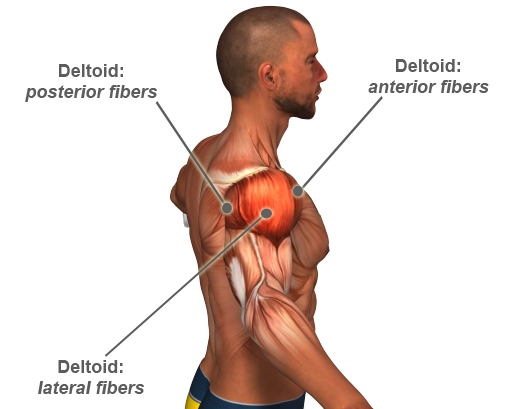
Shoulders are a tricky muscle group.  There are three heads to your “Deltoid:”  The anterior (front), medial (middle), and posterior (rear) heads; each one has it’s own function.


Meet the deltoids!

Meet the deltoids!

Usually, the medial deltoid is a synergist (“Helper”) to the anterior deltoid; the anterior deltoid is also often a synergist to movements involving the pecs.  By this logic, I would make the case for not having a “shoulder day,” and instead, training shoulders with your chest–  Otherwise, your shoulders may not have enough time to recover, and you may not see the gains you want.  This can be seen on a “Legs / Torso / Shoulders & Arms” split, where your shoulders would end up seeing action two of those days, and if you train 6 days a week, then they would be used 4 days–  Not enough time to recover = losing gains = no bueno.

You forgot to mention the “Posterior Deltoid.”

I didn’t forget.  The posterior deltoid is involved in different movements than the medial and anterior deltoids, and thus, I would not include it in a “shoulder day.”  In most rowing movements, and / or back exercises, your posterior deltoid acts as a synergist.  Also, in movements where the posterior deltoid is the agonist (“Prime Mover” or “Target”), many different back muscles act as the synergist–  Which is why your posterior deltoid, when doing a training split, should actually be trained with your back muscles.

Think about it–  If you train all three heads of your deltoid on your chest day (Where shoulders belong on a three day split), that means you’re also working your back on your chest day–  And if you do each body part twice a week, that would make four days that you’re training your back; not enough time for recovery if you want to see gains!

That makes sense.

Training splits can be valuable, but understand that part of the reason for doing a split is to give your muscles enough time to recover–  That’s why it’s often important to think of your muscles in terms of movements, rather than groups.  Putting all shoulder movements together is not ideal, since you’re then combining movements, which defeats the purpose of doing a training split.

Archive for the ‘Body Building’ Category:

Training Related Footwear– What should you wear?

One of the most difficult things associated with achieving your goals, is how to properly measure them.

We have scales. . .

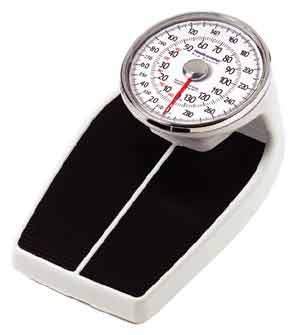
It’s not difficult in the way that you may be thinking.  Let’s take the scale for example.  The scale tells you your weight, and nothing more.  It doesn’t distinguish between fat or muscle, and certainly can’t tell you if you’ve lose some fat while gaining an amount of muscle–  It just tells you a number that too many people put too much stock in.

Pictured: 'The Enemy,' to most people.

Pictured: ‘The Enemy,’ to most people.

What about circumference measurements?

A tape measure can work well as well, but just like the scale, may not always be telling the truth (read: Not always your friend).  The problem with relying purely on these measurements is that the tape measure doesn’t know if you’re bloated.  Likewise, the tape measure is just as dumb as the scale in that it can’t tell the difference between different types of body mass.

What about X?

Unless you pay for really expensive testing, there will probably be an issue with the method of testing you bring up, and paying for really expensive tests every week or two is not practical.

So what do I do then?

Many trainers opt for the “Mirror Test,” and I’m definitely an advocate of this, as well!  Here’s how simple it is:

  1. Stand in the mirror.
  2. Observe.
  3. Ask yourself, “How do I look in the mirror?”
  4. Do you like the changes you’re seeing?  Assess.

Most people can’t really notice these changes since they see their bodies every day, and in that case, you can do the “Modified Mirror Test:”  Take some pictures regularly, and compare these.  What has the result been?  Sure, you can use the scale to get a very general idea of where you’re headed, but you must put very little stock in that number.  If you’re looking better, but weighing more, this is just as good as looking better but weighing less;  both are positive benefits, and you should not let that number on the scale hurt you!  It’s only a number!

Except this three.  It really is a monster.

Except three. It really is a monster.

The Mirror Test may not be scientific, but the end result of most plans should be achieving a sort of aesthetic, whether it’s an extreme case like bodybuilding, to someone overweight who wants to be healthier, or someone who simply wants to “tone up;” the mirror test will tell you all that you need to know, and is fantastic for your sanity!

Archive for the ‘Body Building’ Category:

Training Related Footwear– What should you wear?

Must be.

Must be.

We’ve been working very hard on finishing up the website, and eventually I had to write some content that dealt with the results that can be achieved through personal training, or being prescribed a workout plan / nutrition plan.  When it comes down to it, I had to admit that I can’t guarantee anyone results.

The truth is, any trainer that “guarantees” success is doing something wrong.

How can you say that!?

Here’s what I ended up writing, and it is definitely true:  “Understand that results are not guaranteed–  All goals achieved are the product of four things: A solid plan, a committed trainee, dedication, and self control.  I am only providing you with the first item–  You have to bring the rest.”

You must have a solid plan in place based around tried and true principles, which is what I’m here for.  On top of that, you have to be committed to your goals–  Make S.M.A.R.T. goals (Specific, measurable, attainable, realistic, timely) and commit to them.  You must be dedicated to your success.  More than anything, though, you must have self control.

Can you say I’m wrong?  As a trainer, I’m not the one cooking your meals.  As a trainer, I’m not the one whose goals are on the line.  As a trainer, I’m not there to remind you about your calories and macros.  As a trainer, I can’t guarantee you’ll do everything I recommend.

Can you be my “Personal Nanny”?

When it comes down to it, I’m your personal trainer.  I’m in charge of creating a solid plan, and taking all of the guess work out of your training and nutrition.  If you come to the table committed, dedicated, and willing to exert self control, we can achieve anything together.

Recent Blog Posts